
The longest lull in solar activity in 5 years has come to an end
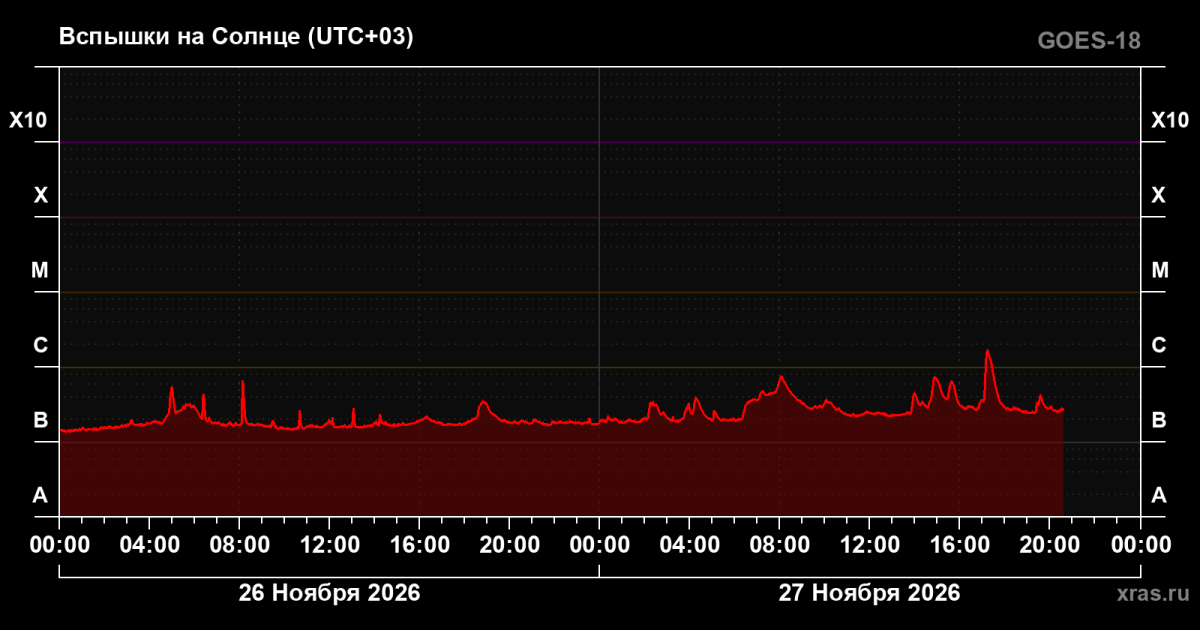
The lull in solar flares, which began midday on November 20 — last Friday — has come to an unexpected end. The graph of the Sun’s X-ray emissions, the primary indicator for solar flares, began to shift slightly yesterday, hinting at a potential rebound, and by this morning, it was clearly trending upward. Around 14:00 UTC, following several attempts, the readings crossed the "C-class" threshold — the level at which standard solar flares are recorded. The peak of the flare — which has now been officially entered into global catalogs — was logged at 17:13 Moscow time. It was classified as a C1.6 event; objectively, this is a very low value — one that would typically go unnoticed, were it not for the preceding seven days of total silence.
This hiatus in solar activity lasted approximately 171 hours, marking the longest such interval since late 2021. Back then, between November 13 and December 4, 2021, the Sun went 500 hours without producing a single flare of C-class or higher. That same year—the final "quiet" year before the onset of the current solar cycle — saw two other extended lulls: one lasting 281 hours (October 14–25) and another lasting 174 hours (June 1–8).
The recurrence of such prolonged dips in activity, following a five-year gap, raises the question of whether solar activity is declining much faster than current models predict — suggesting that the solar minimum, previously forecast for 2030, could arrive significantly sooner. It is worth noting that October — last month — saw the lowest number of sunspots recorded since November 2021; the integral index reached only 45.7, whereas as recently as mid-2024, it had exceeded 200.
The current uptick in solar activity is linked to the emergence of two new sunspot groups on the Sun’s eastern (left) limb — regions that have rotated into view from the far side and have been assigned the numbers 4583 and 4584. A solar flare was detected within the second of these, region 4584. It remains unclear how sustained this increase might be; for now, the event is viewed as an isolated occurrence, insufficient to lift solar activity from its current low point.