
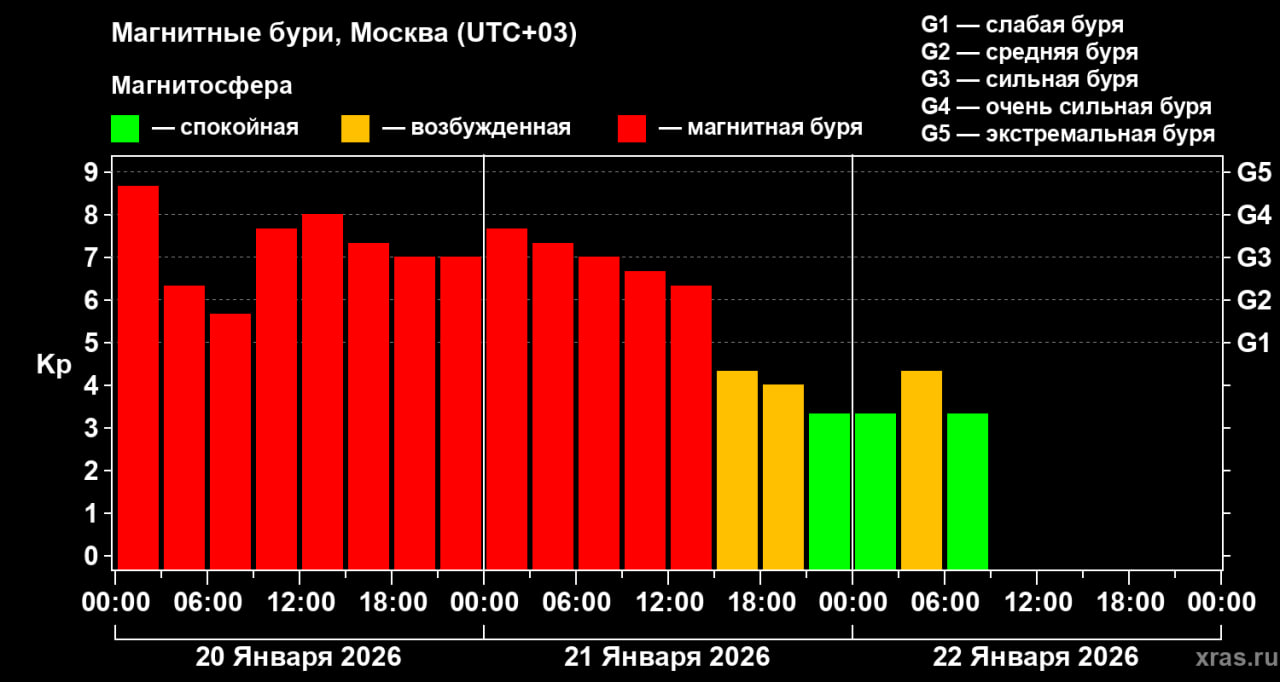
The first strong magnetic storm of 2026, which also became one of the most significant events of the 21st century, has ended. Geomagnetic indices exited the red zone yesterday, around 4:00 PM Moscow time, and have now stabilized at Kp=3-4, separating the Earth's quiet magnetosphere from a weakly disturbed level.
The storm was a reaction to an X1.9 flare, classified as the highest intensity category, which occurred on Sunday, January 18, around 9:00 PM Moscow time. The event was registered in active region 4341, which earlier in the first half of the month produced two large explosions while still on the far side of the Sun. By the 18th, due to the Sun's rotation, it had moved to the side visible from Earth. At the time of the explosion, it was located precisely on the Sun-Earth line. This location partially explains the exceptional force of the subsequent impact on the planet, but not entirely, as a number of facts are extremely difficult to fit into basic understanding of solar activity.
The main, difficult-to-explain consequence of the explosion was an exceptionally powerful radiation storm, accompanied by the strongest increase in the number of energetic protons (with energies exceeding 10 MeV) in the vicinity of Earth in the 21st century. Over the course of 24 hours, the density values rose to 37,000 units, exceeding the "red level" threshold by thousands of times and the most powerful flares of the current cycle by 20 times. These values surpassed the seemingly indestructible records set at the beginning of the century, then recorded after the largest flares of this century (approximately 30,000 units), and fell just short of breaking the all-time record of 43,000 units, recorded back in the 20th century. The causes and consequences of this event (including the radiation dose received by spacecraft during that 24-hour period) remain to be determined. It can only be noted that the resulting increase in protons disabled the sensors of the ACE spacecraft, which measures the velocity of solar plasma in orbit, and for this reason, the precise speed of the plasma ejection reaching Earth is still unknown.
In terms of magnetic storm strength, the event, contrary to expectations, did not reach the highest level of G5, stopping just short of it at G4.7. Thus, the twenty-year record for this indicator, set two years ago on May 10-11, 2024, remains unbroken. Two other storms in this cycle reached a similar level to the current event: on October 11, 2024, and November 12, 2025. The total duration of this storm was approximately 42 hours.
The event was accompanied by exceptionally strong auroras, which were observed as far north as Crimea and, generally, along the southern borders of the country. It's highly likely that the sky over Moscow was also colored for two days, which would have been observable even despite the light pollution in the large city. However, both days were covered by solid clouds, as was the case with St. Petersburg, where the auroras were even brighter. Nevertheless, numerous photographs received from various, often completely unexpected, regions of the country clearly demonstrate the exceptional power of the event.
At this point, solar wind parameters have completely returned to normal. The plasma ejection passed by Earth and is moving on toward Jupiter, and, as already noted, was expected to pass (or is about to pass) Comet 3I/ATLAS tonight, which is en route to Jupiter. The Sun has returned to its normal pattern and is currently in a state of moderate activity. Flares and further moderate magnetic storms are possible in the coming days, but the planet is unlikely to experience such powerful events for a long time.