
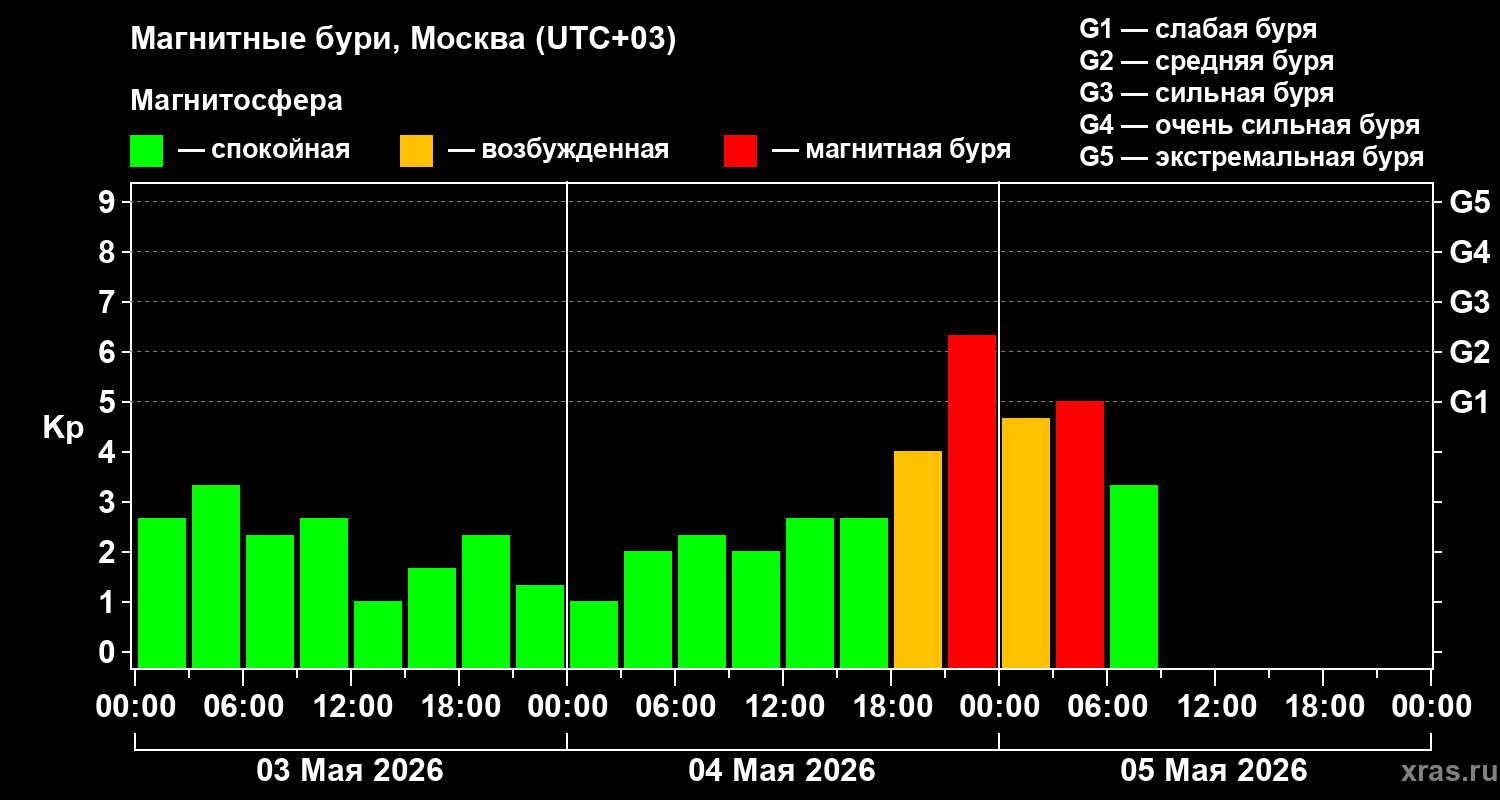
On the night of May 4th-5th, against the backdrop of the "green light" anticipated throughout the May holidays, quite noticeable magnetic storms began, peaking around midnight and reaching G2 (moderate storm) levels. Their source was a relatively weak event—a slow coronal plasma ejection (CPE), which had been recorded on April 30th and modeled around the same time—the model can be viewed at this link. Frankly, although mathematics is smarter than humans, it was hard to believe that this structure wouldn't disintegrate and dissolve during its nearly week-long journey from the Sun to Earth. Ultimately, it slowly made its way, striking the planet last night. Let's celebrate the calculation models—if they had emotions, we'd probably be proud of such a calculation. We almost certainly would have been.
As is often the case with nighttime events, the storms triggered quite noticeable auroras, peaking at approximately a level 8 on a scale of 10. We apologize to everyone for not issuing a message yesterday—there was a glitch in the internal warning system. It's possible this was one of the last chances to see the auroras before autumn. It's expected that with the onset of summer, even very large geomagnetic events will no longer be able to trigger anything—the nights are too short, the skies too bright.
Flare activity is low. In approximately 3-4 days, a large active region should appear on the eastern (left) limb of the Sun—it's already being seen on the far side by the Solar Orbiter satellite. This is expected to trigger another wave of activity. There's almost no energy on the visible side, although there are quite a few active groups (sunspots). The flare graph, with the exception of isolated outbursts, is drawing a nearly straight line.