
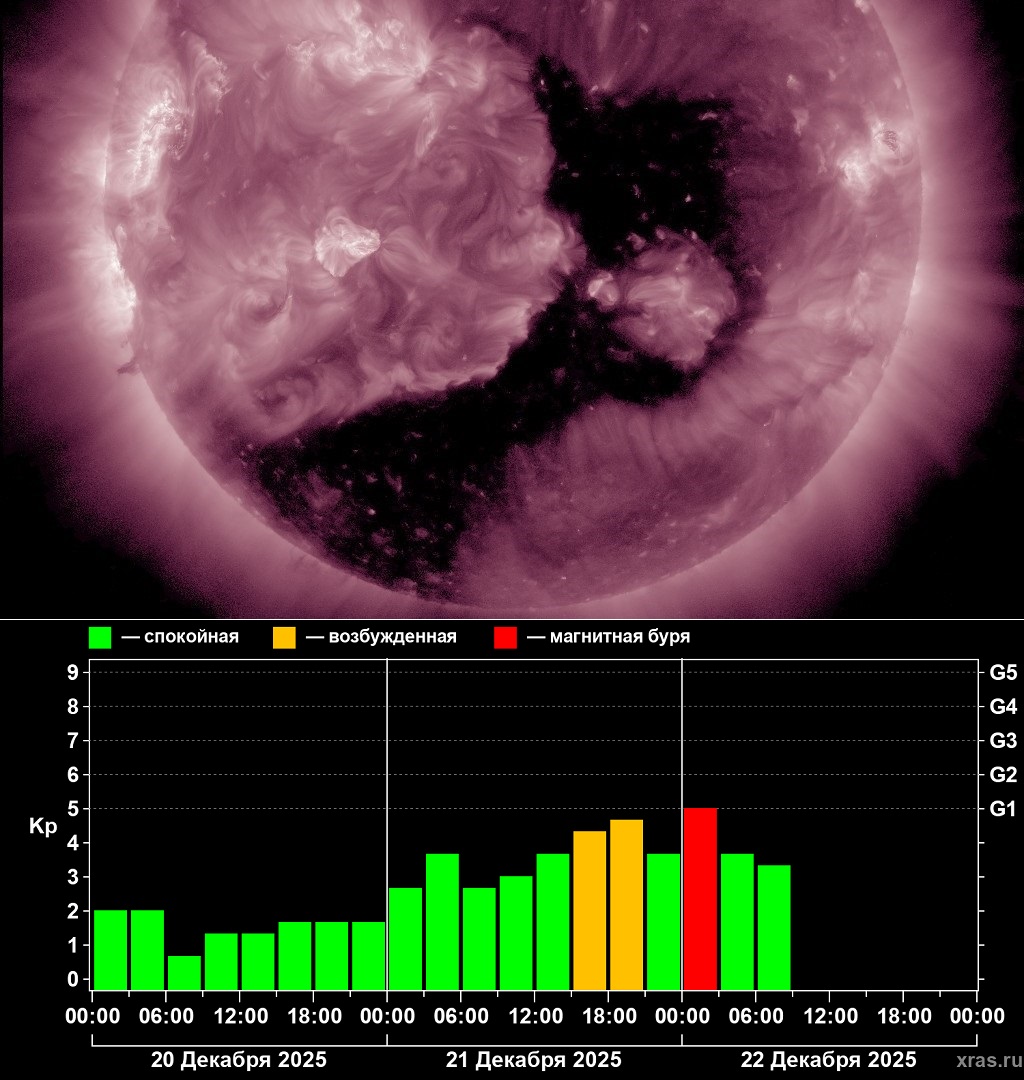
Approximately a day ahead of schedule, signs of a disturbed solar wind flow from a coronal hole forming on the Sun affecting Earth began to be recorded in the vicinity of the planet. A corresponding complex structure is currently observed in the center of the solar disk, encompassing the southern and part of the northern hemisphere. Around midnight Moscow time, the first short magnetic storm of level G1 was recorded.
The fast solar wind, propagating in the plane of the planets, including the one affecting Earth, originates primarily from the equatorial parts of coronal holes. By drawing a corresponding line across the solar disk, one can see that the hole in this region has a particularly complex shape. For this reason, the geomagnetic forecast for the coming days is quite unstable: both moderate disturbances are possible if plasma streams from the central part of the hole, where large ruptures are observed, reach the planet, and prolonged storms of level G2 are possible if a plasma stream from the overlying region of "solid blackness" descends into the planetary plane.
The solar wind velocity near Earth is currently quite high—around 700 km/s, roughly twice the normal rate—and is likely to remain at this level for the next 2-3 days, and possibly longer. Under such strong pressure, the magnetosphere will likely be very sensitive to even the slightest changes in other wind parameters, especially the strength of the interplanetary magnetic field. Each touch of the orange line on the corresponding graph will likely trigger weak to moderate magnetic storms in the coming days.
Globally, geomagnetic activity is assessed as moderate. Coronal holes alone, without the help of flares, are only capable of raising Earth's magnetic field above G1-G2 storm levels in exceptional cases. Flare activity in recent days seems to be trying to restart occasionally, but so far without much success. The engine sputters and coughs, and sometimes even starts briefly, but quickly stalls. There's no power.