
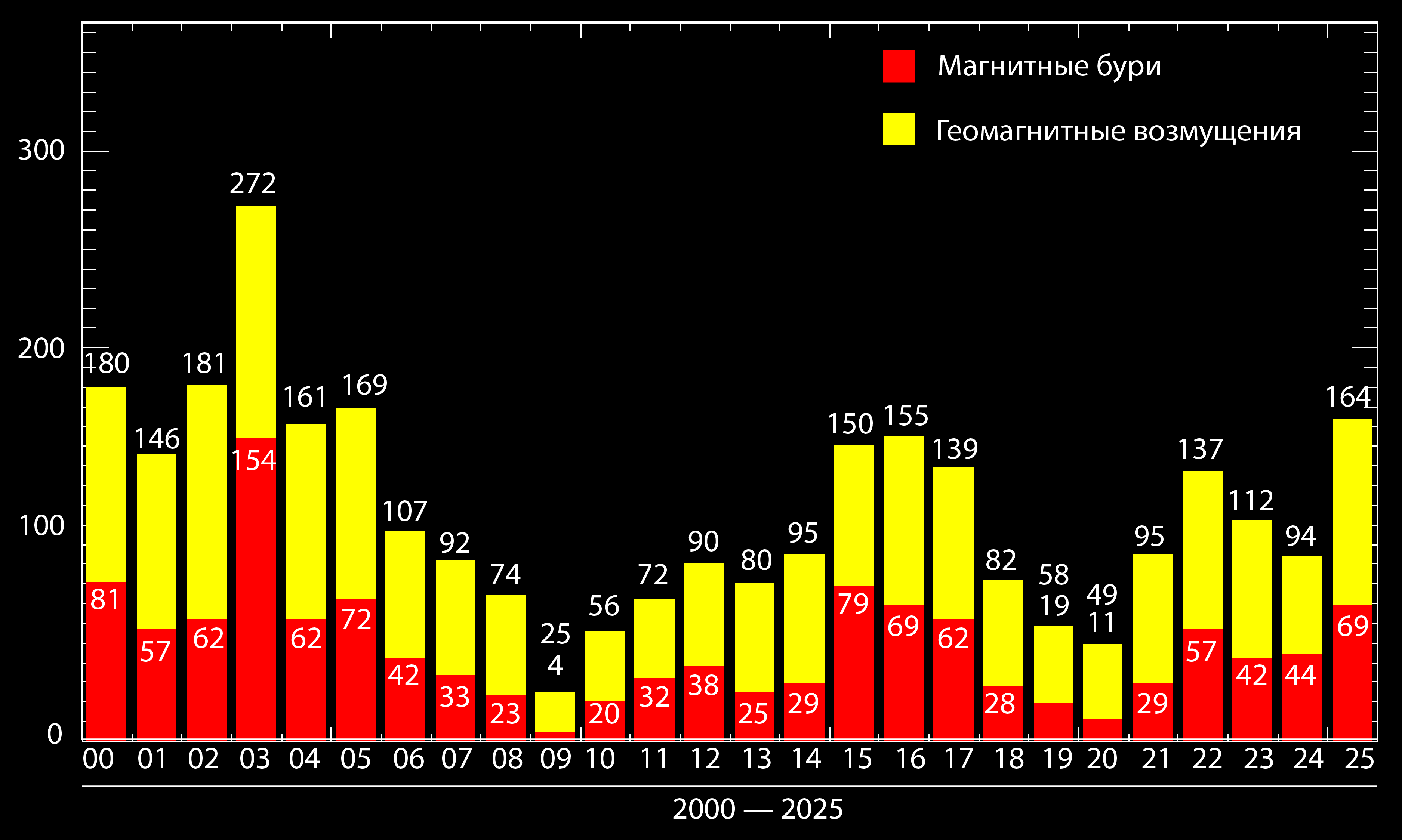
The number of days with magnetic storms and the total number of geomagnetically disturbed days in 2025 significantly exceeded last year's figures, becoming one of the highest in the past two decades. Over the 358 days since the beginning of the year, magnetic storms have been observed in 69 cases, compared to 44 in 2024. An even more significant increase was the total number of days with geomagnetic disturbances, on which the Kp index reached a value of 4 or higher (yellow and red levels). There were 164 of these compared to 94, a 75% increase.
Comparable and higher numbers of days with magnetic storms were last achieved in 2015 (79 cases) and 2016 (69 cases), that is, 10 years ago. The 2016 figure, however, will almost certainly be surpassed during the remaining week of the year: a large coronal hole continues to affect Earth, and the necessary storm could occur as early as today. In terms of the total number of geomagnetically disturbed days, the last time higher values (169 days) were observed was in 2005, that is, 20 years ago.
The main factor influencing the increase in storms was the unusually large number of coronal holes on the Sun, which began forming en masse in the first months of the year. While the term "coronal holes" was still largely unknown last year, these structures now completely dominate the news cycle, eclipsing flares and other solar activity phenomena. Since there are no signs yet of a systematic decrease in the number of coronal holes or a reduction in their size, it can be expected that at least the first months of 2026 will continue to be significantly influenced by them, and the increased number of magnetic storms will persist.
The absolute record-holder for the 21st century is 2003, when 272 out of 365 geomagnetically disturbed days were recorded, including 154 days with magnetic storms. This is what some months of the year looked like back then: March 2003, May 2003, and, of course, October and November 2003 — the two months that saw the largest series of solar flares in the 21st century. However, December 2025 also looks quite impressive against this backdrop: 12 geomagnetically disturbed days were recorded in the 24 days of that month, including six with magnetic storms.
The absolute minimum of the 21st century was 2009. Over 365 days, only four magnetic storms were recorded. The relatively recent years 2020 and 2019 rank second and third in the ranking of quiet years, with 11 and 19 storm days, respectively.