
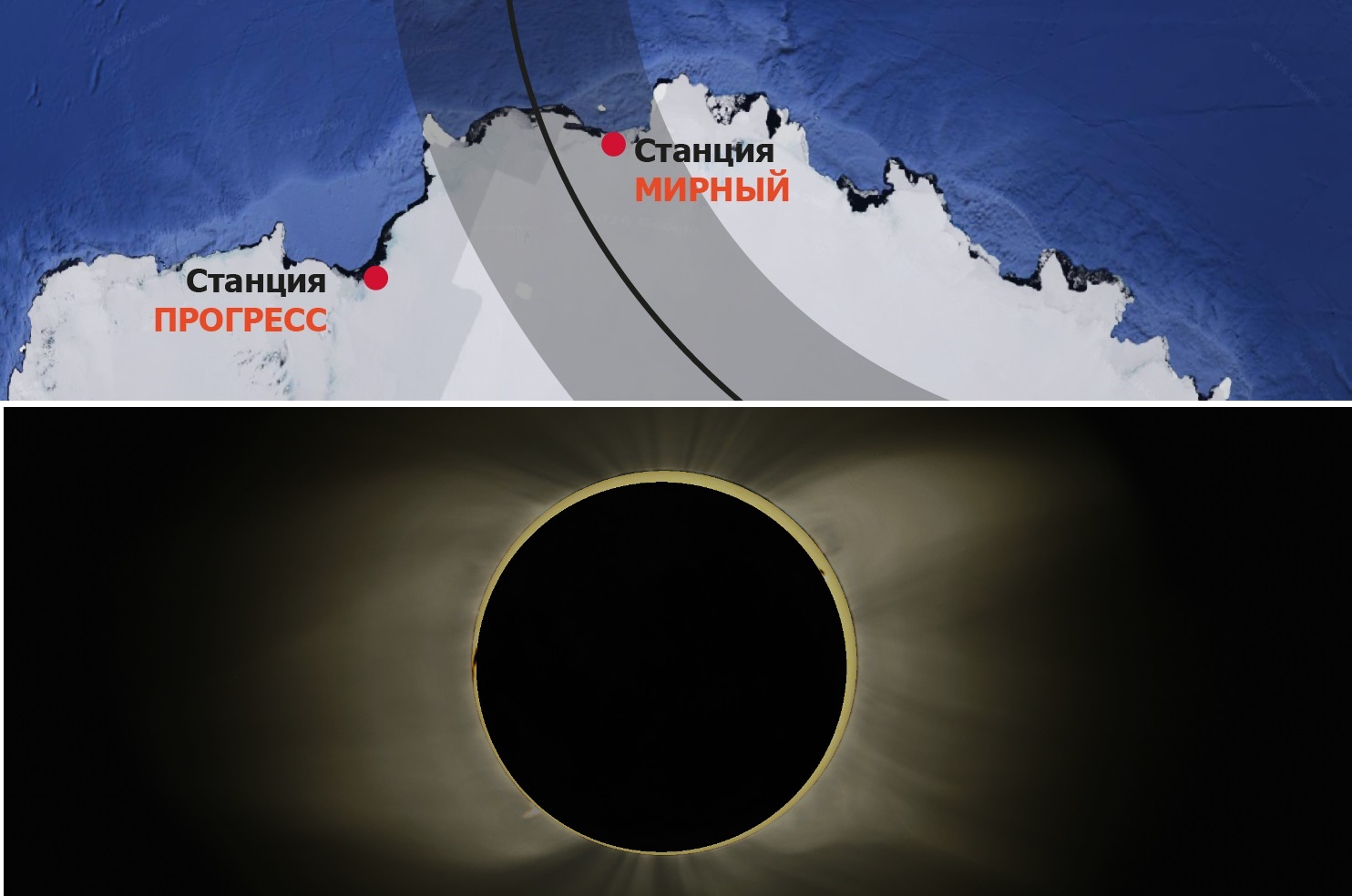
An annular solar eclipse — a rare astronomical phenomenon in which the Moon passes across the Sun's disk but is not large enough to completely cover it — will occur on Earth next Tuesday, February 17, from approximately 11:50 to 12:36 UTC. The solar disk will only be visible in Antarctica, and the number of spectators who will witness it with their own eyes is likely to be the smallest in the 21st century—most likely just a few people. The only one of dozens of Antarctic stations within the annular path of the eclipse is Mirny Station, located on the coast of the Davis Sea. The nearest stations, Davis Station (Australia) and another Russian station, Progress, will be outside this zone, although they will be able to see the Sun as a crescent, partially occulted by the Moon (but not the annular path).
Typically, eclipse attendance is significantly boosted by scientists, who sometimes travel to such exotic locations for rare images of the solar corona that one can only be amazed. But not in this case. During annular eclipses, the corona is invisible, and this time, science will stay home. Mass scientific tourism is expected this year during the second eclipse, on August 12, 2026, which will be total and take place in more accessible locations, if we consider Iceland and the east coast of Greenland.
The next annular eclipse will occur approximately a year later, on February 6, 2027, and will be visible from South America. The next favorable eclipse for Russia will not occur until August 2, 2027, when the partial occultation of the Sun by the Moon will be visible from the European part of the country.