
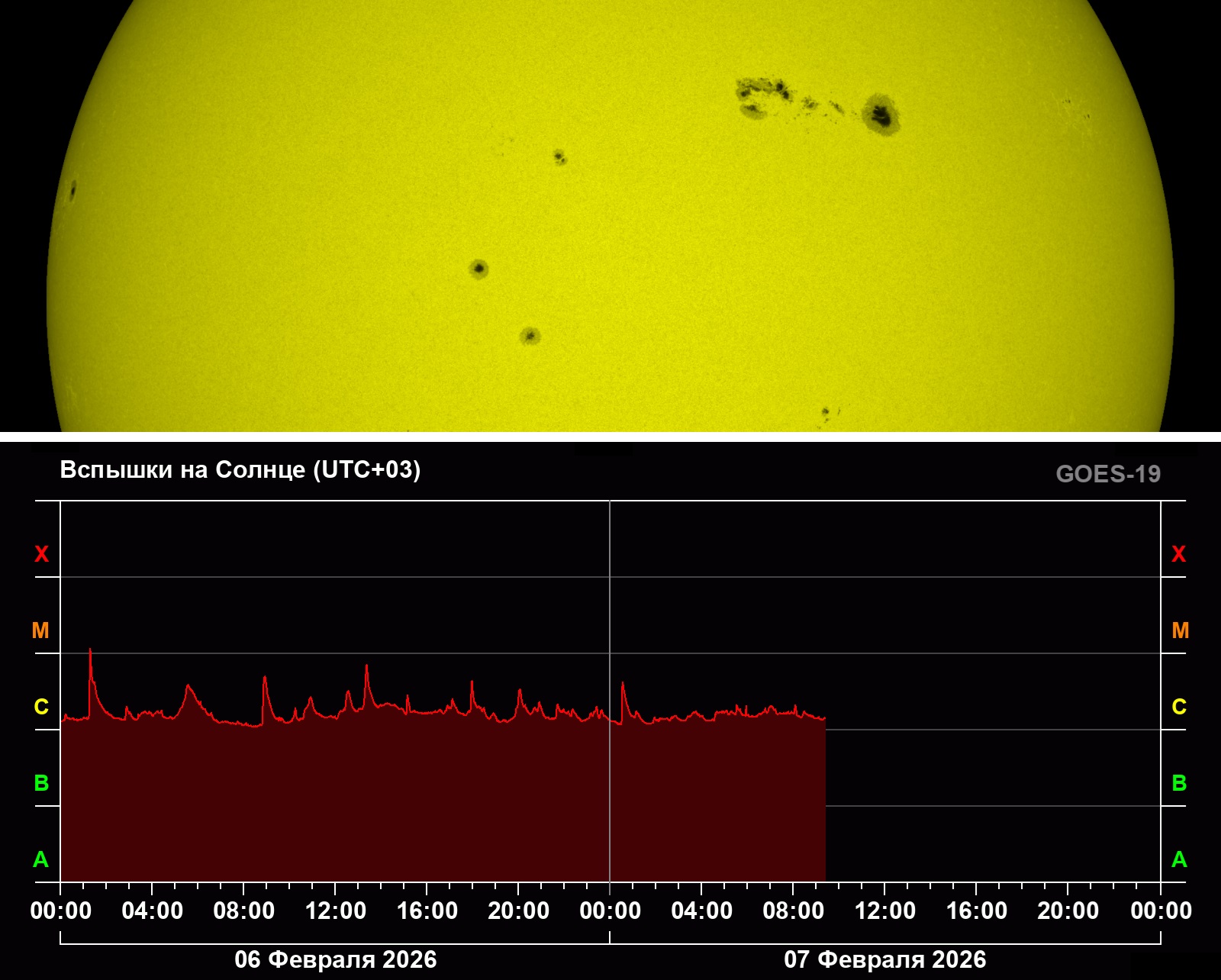
One of the most powerful solar activity surges of the 21st century, observed since early February, ended as suddenly as if someone had pulled a switch. Active region 4366, raging opposite Earth and just one event away from tying this century's record for the number of strong flares and two events away from breaking it, simply stopped flaring. Just the day before, on Wednesday and Thursday, February 4th and 5th, 11 M- and X-level explosions were registered there. Yesterday, on Friday, this number dropped sharply to zero, and today, with the start of the weekend, the solar activity graph has degenerated into an almost straight line.
One of the main mysteries that science must now decipher is the almost complete "sterility" of the active center. Several very large flares that occurred during these days while the active center was in the zone of maximum influence on Earth, each of which could have created a high-level magnetic storm, resulted only in weak, episodic disturbances of the Earth's magnetic field. Not a single "black swan" event, anticipated over the past few days, has emerged from the Sun. The impact of the flares was apparently neutralized by some peculiarities in the configuration of the active region, as a result of which none of the flares was able to form and eject a large plasma cloud into space—an almost inevitable attribute of major events, whose arrival at Earth upsets the magnetic field's equilibrium.
At present, the Sun is likely to enter another period of stabilization, the duration of which, however, is difficult to predict. Since the beginning of 2026, two exceptionally large bursts of activity have already occurred, one of which, in January, produced the strongest radiation storm near Earth in the 21st century, and the second, in February, nearly broke the record for the number of major flares. Yesterday, very powerful explosions occurred on the far side of the Sun, indicating that the star retains significant energy reserves. Nevertheless, some period of calm is still guaranteed—we will see how long it lasts.
It's worth noting that active region 4366 will remain in Earth's field of view for at least another 5 days, so it still has a theoretical chance of breaking this century's record. To do so, it will need to gather its remaining energy during these days and produce two flares of at least M1.0 magnitude.