
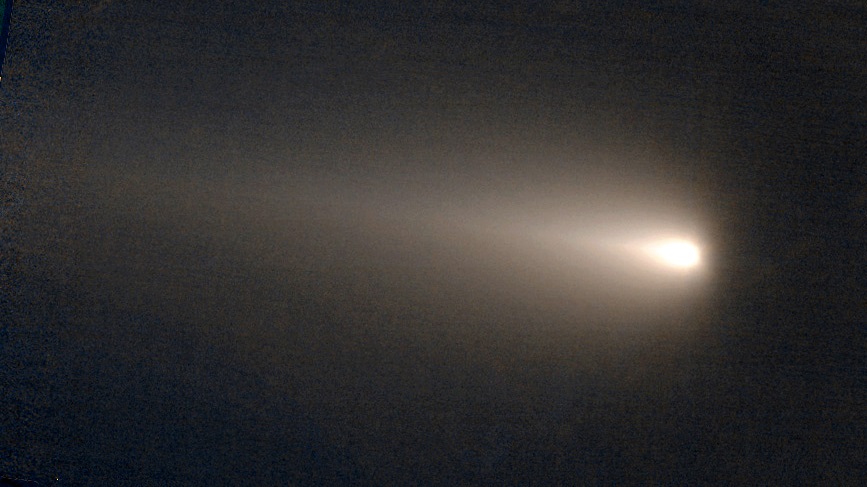
Comet C/2026 A1 continues to move toward its fate, which, unfortunately, currently appears to be extremely bleak. In just 18 days, on April 4th at approximately 5:00 PM Moscow time, the celestial body will make a close approach to, or even impact, the Sun.
A direct encounter with the Sun, however, could be considered a positive outcome. The vast majority of celestial bodies, even those a kilometer or more in size, are completely destroyed at distances of several million kilometers from the Sun, perishing in the struggle against increasing radiation fluxes, enormous centrifugal accelerations, and the ever-increasing density of the surrounding solar wind. In the 21st century, only one large body has managed to pass at a comparable distance from the star. In December 2011, comet C/2011 W3 managed to accomplish this feat, losing up to 90% of its mass, losing its tail, and ultimately disintegrating into fragments. Examples of the opposite are far more numerous. The most recent such case occurred relatively recently: on October 28, 2024, comet C/2024 S1, which some predicted would be the brightest comet of the decade, simply evaporated like a drop of water upon approaching the Sun to a distance of approximately 2 million kilometers, as directly observed by solar coronagraphs.
The possibility of a collision or divergence between a celestial body and the solar surface remains uncertain if it manages to pass the first stage of this game and proceed to the second stage—a direct encounter with the star. Barycentric models (which take into account the center of mass of the Solar System), including the corresponding NASA JPL visualization, continue to predict a direct collision between the celestial body and the star. Currently, a transition from barycentric to heliocentric motion (gravitation toward the center of the Sun) is occurring, which, according to the same calculations, is capable of deflecting the body from instantaneous destruction and keeping it 100,000-200,000 km above the surface. All these calculations must also factor in the comet's deceleration by ejected masses of matter. Although the tail of the comet sometimes creates the illusion that reactive forces are pushing the comet forward, in reality, gas evaporation and dust ejection occur predominantly on the side facing the Sun. Therefore, this effect decelerates the celestial body and facilitates its capture by the Sun. These forces will become especially significant in the final hours before its approach to the star, when the comet begins to lose matter at a breakneck pace.
The comet's rapid destruction processes, which may begin as early as the end of March, should contribute to a rapid increase in the body's brightness 2-3 days before its approach to the star. Currently, the celestial body continues to increase in luminosity and has already reached a psychologically significant barrier—the tenth magnitude—moving it into second place among the nearly 100 comets currently visible in the sky. The leader of the list, comet C/2025 R3, is predicted to be displaced in about a week. The comet's explosive disintegration and intense mass loss in early April are believed to accelerate the length and brightness of its tail to levels where it will become visible to the naked eye at least in the sunset sky, and possibly in the daytime sky, including from Russia. The possibility of observing the comet after passing the star currently appears purely hypothetical—it would have to undergo too many stages of its quest to reach that level. It can be seen that in this case, the comet would return along exactly the same trajectory it took on its approach to the Sun and would once again return to our country's sky.