
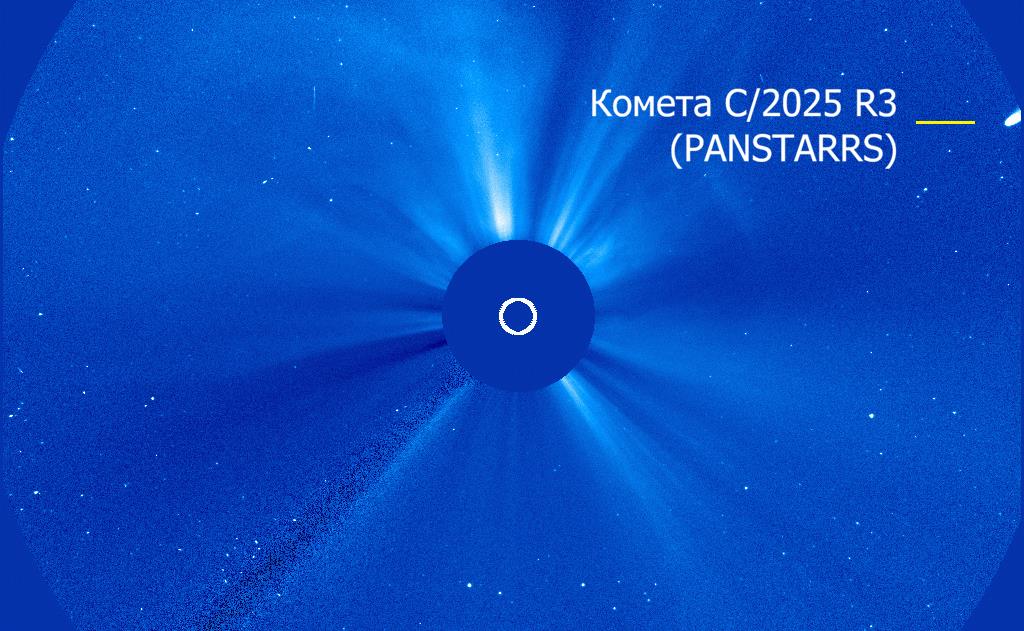
The passage of the brightest comet in the sky, C/2025 R3 (PanSTARRS), past the Sun will be visible in images coming from space over the next three days. The comet has just entered the field of view of the LASCO solar coronagraph and will be visible until the end of Sunday. Updated images of the celestial body during this period will be available on our website, among other places.
The object currently ranks first in the catalog of comets with a brightness around magnitude 4, which is actually quite insignificant. Nevertheless, the photometric sensitivity of the LASCO telescopes is sufficient to observe in detail the entire process of the comet's passage past the Sun, as well as the structure of the comet's nucleus and tail. Overall, after the recent demise of the former catalog leader, C/2026 A1 (https://t.me/lpixras/2373), no truly interesting comets remain in the sky, and they are almost certainly not expected to appear in the next six months. For this reason, we have to observe what we have. The next three days represent, in effect, the last opportunity to see a bright comet near the Sun in the coming months.
Last Sunday, April 19, C/2025 R3 passed at its closest approach to the Sun (approximately 75 million kilometers) and is now departing, scheduled to return in 170,000 years—roughly the orbital period of the celestial body. Generally, a flyby at this distance is relatively safe, although some risks remain. Let's wish the comet a safe passage through this period.
The approximate position of the celestial body in LASCO images is shown in this diagram. The comet will disappear from the instrument's field of view on the night between Sunday and Monday.