
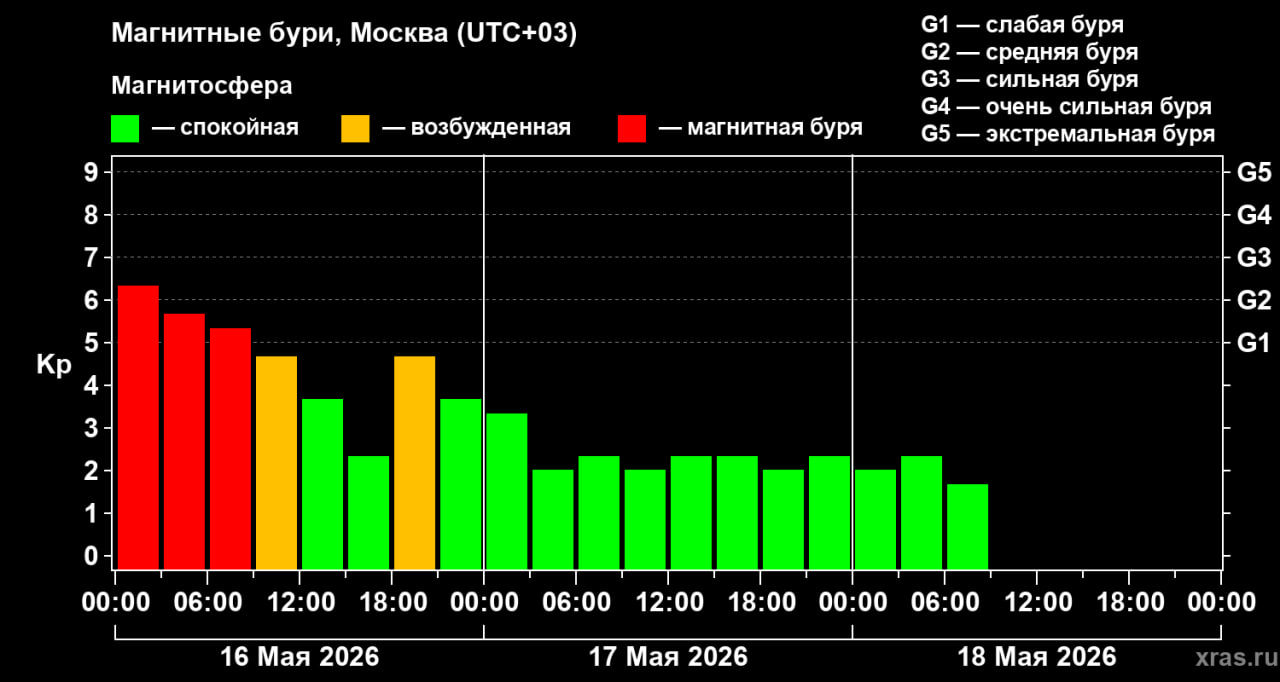
Space weather remains disturbed. In terms of its impact on Earth, the main factor remains the ongoing influence of a large coronal hole. Although the magnetic storm graph, which has returned to the green zone, gives the impression that everything has ended, in reality, the solar wind speed remains significantly elevated (in the range of 500–600 km/s versus the usual 300–400 km/s), and it's not so much a question of the influence subsiding as of acclimation to it. The magnetosphere has found a point of equilibrium with the new conditions. Within 24 hours, a weak mass ejection from the rather significant flare that occurred on May 16th should reach the planet, almost certainly upsetting this equilibrium. A model of the ejection's movement can be found here. Calculations indicate that, against this backdrop, the indices should return to the red zone—to the level of weak storms.
Flare activity is uneven and jittery. On the otherwise empty graph, noticeable events occur here and there without apparent cause. The Sun will likely remain in roughly the same pattern throughout the first half of the week. In any case, there are no apparent reasons for major flares, but there also seems to be no reason for activity to subside. Some rather interesting events are occurring on the far side of the Sun, but we'll write about them separately later.