
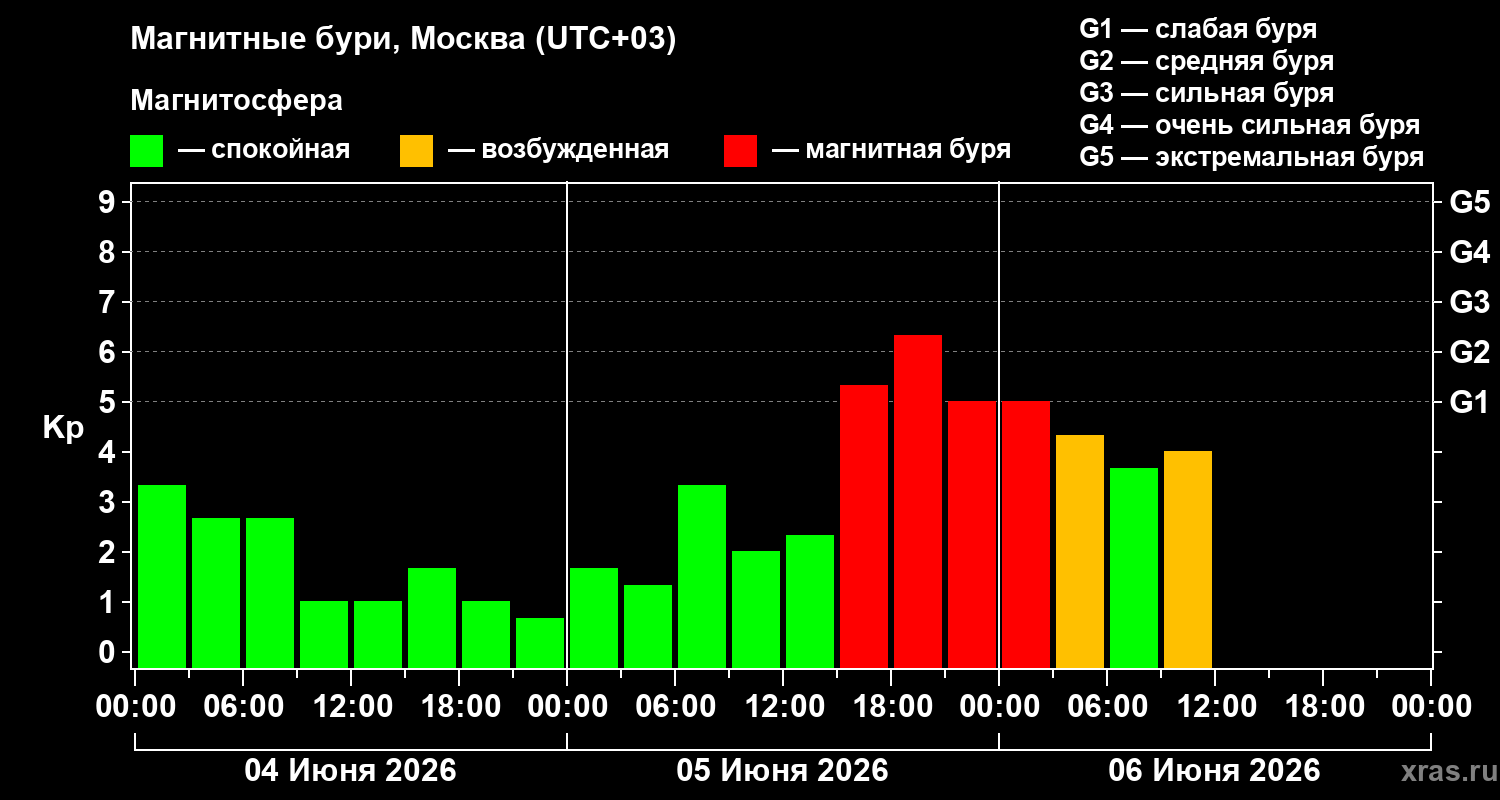
Based on the plasma parameters currently recorded in the space surrounding Earth, the geomagnetic event has concluded. Minor residual disturbances persist, sustained primarily by the increased solar wind velocity. Other parameters (temperature, density, and magnetic field strength) have returned to normal.
The storm was predicted in advance after three flares near the highest magnitude X (one even reached it) occurred in the very center of the visible solar disk on Wednesday, June 3, accompanied by plasma ejections toward the planet. Calculation models, assuming the usual scenario for such events—that later ejected plasma clouds would overtake earlier ones and merge into a single structure—predicted the second or third strongest magnetic storm of the year, expected to peak at G3-G4. In fact, no merger occurred, and the plasma cloud velocities were overestimated. When the first cloud finally reached Earth after a 10-hour delay (yesterday around 4:00 UTC), it became clear that no records would be set. The Earth's magnetosphere reacted to the plasma's arrival with rare indifference, and it seemed that not even a minor disturbance would occur, let alone a storm. However, in the middle of the day, the arrival of the second and third clouds, which almost merged into one, finally pushed through the exhausted magnetosphere and triggered a storm, albeit a mild one.
The event peaked yesterday around 5:00 UTC and reached G2.3—roughly halfway between the moderate and strong categories. Overall, the event lasted for about 10 hours—from approximately 13:00 until 23:00 UTC. Residual disturbances are currently observed, but they will soon dissipate.
The geomagnetic forecast for the weekend is favorable.