
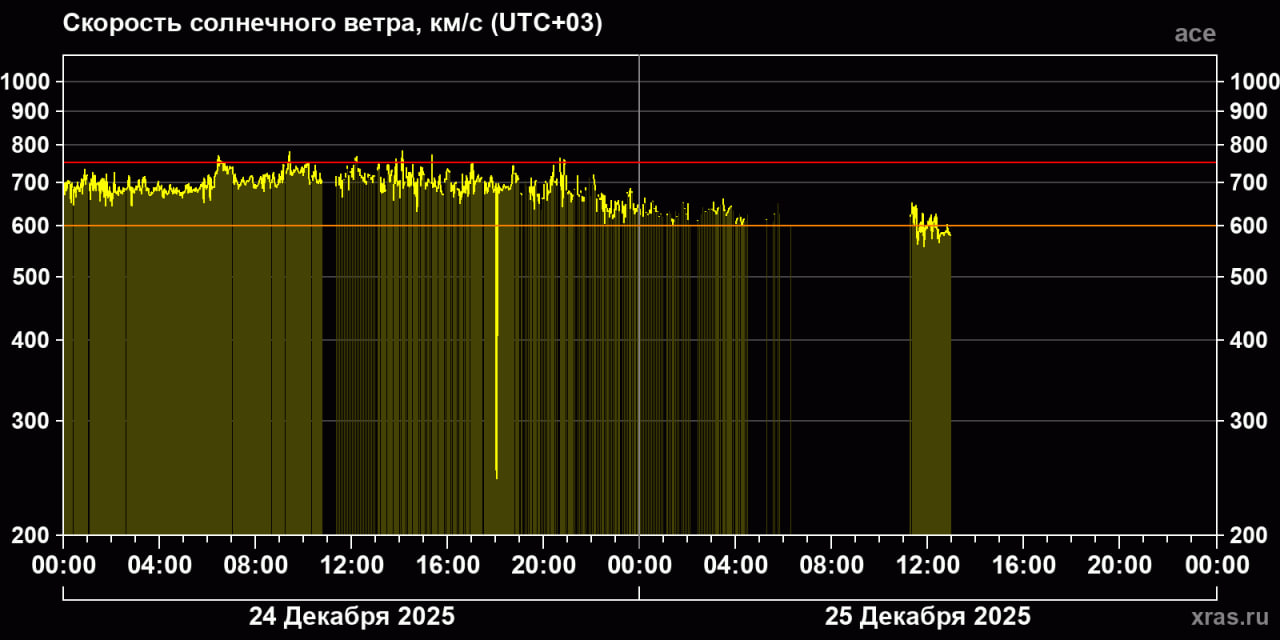
For those tired of seeing gaps and interruptions in incoming solar wind data, there's little good news at the moment.
DSCOVR, the world's leading spacecraft and the primary source of data in recent years, failed due to a software glitch back in July of this year. Several attempts were made to restore it to service, but in each case, the data coming from onboard was corrupted and was shut down. For the past six months, the ACE spacecraft, launched in 1997 and located, like DSCOVR, at the L1 Lagrange point, 1.5 million kilometers from Earth, has been used as a backup source. At this distance, the Earth's magnetosphere is unaffected, allowing the instruments to measure the solar wind without the distortions introduced by the Earth's magnetic field. Clearly, the 28-year-old spacecraft is squeezing everything out of its capabilities, but miracles don't happen. In the last couple of months, the situation has become even more dire: up to 50% of the data is being lost per day.
Strictly speaking, there is another satellite at the L1 point capable of measuring solar wind parameters—Wind—but it was launched even earlier than ACE, in 1994. Furthermore, it is technically a scientific satellite (under NASA, not NOAA, jurisdiction), and the legal scope for its use in space weather monitoring is unclear. Wind's technical status is also unclear.
As far as we can tell, NOAA's current primary focus is the SWFO-L1 spacecraft, which was launched on September 24 of this year and is equipped with new instruments for measuring solar wind parameters, as well as a new solar coronagraph, CCOR. The latter could potentially replace the LASCO coronagraph, which has also been in space for over 30 years. SWFO-L1 is currently on trajectory to the L1 point, where it is scheduled to arrive in January 2026, that is, within a month. If the spacecraft successfully enters its designated orbit and successfully tests its equipment, new data should begin arriving in mid-2026. However, given the current situation, there is hope that NOAA will turn on the satellite earlier, in the spring. Specifically, in early December, NOAA began pre-activating and testing some of the instruments during the flight phase, and on December 11-12, it even published the first test data from the magnetometer (MAG) and plasma parameter meters (SWiPS). This alone suggests that efforts will be made to shift SWFO-L1's testing and commissioning schedule as far to the left as possible.
It's worth noting that after the satellite's operational phase, its current, unassuming operational name will be replaced by a much more elegant one: SOLAR-1. If all goes well, it will become familiar to everyone monitoring space weather by the middle of next year.