
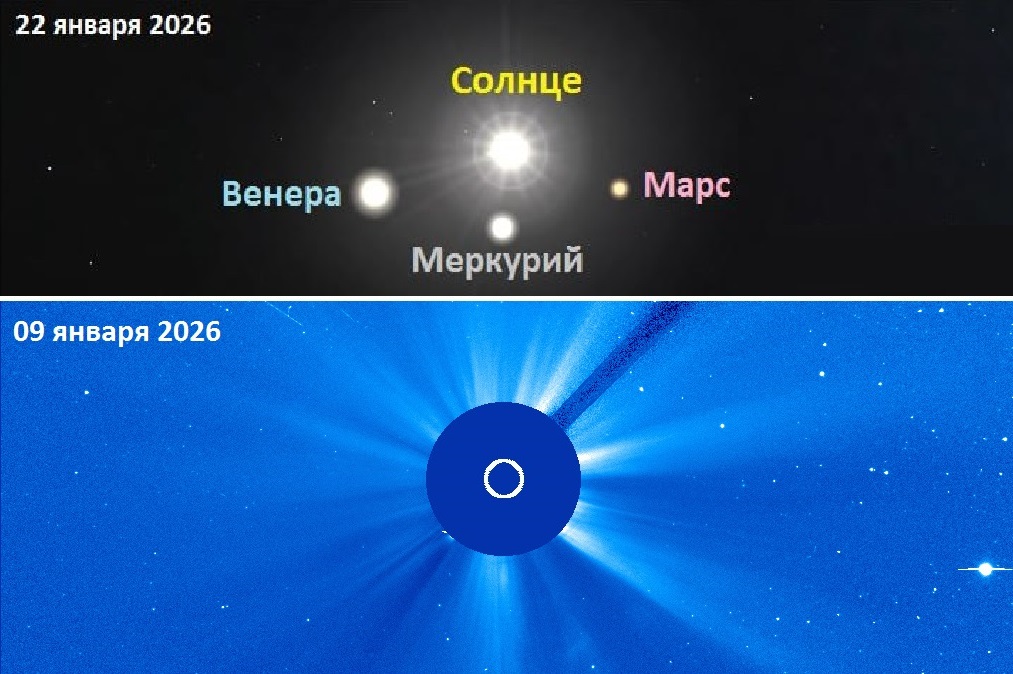
A full parade of all three planets closest to Earth—Mercury, Venus, and Mars—will gather near the Sun over the next two weeks, beginning on January 22nd. Venus and Mars have already approached the Sun, forming a conjunction unique in the next two centuries last Christmas, and are now moving apart. Venus is moving to the left of the Sun, and Mars to the right. Mercury appeared yesterday in images coming from space (today's image is shown below) as a bright star located on the right edge of the frame, and will now move rapidly toward the solar disk located in the center of the image. Venus and Mars are not yet visible in this image—both planets are still so close to the Sun that they are hidden behind the coronagraph's artificial moon (the blue disk in the center), which blocks bright sunlight, hindering the instrument's operation. It will take several days for both planets to move far enough from the Sun to emerge from the obscuring disk and appear in images coming from space.
By January 22, the three planets and the Sun will align in a final symmetrical configuration, forming a nearly perfect rhombus in the sky, or, if you prefer, a cross, with sides measuring 2-3 degrees. After this, the parade will begin to disintegrate. The fastest planet, Mercury, will be the first to move away from the Sun, before the end of January. During February, Venus will move away first, followed by Mars. The next, much wider (within 10 degrees) conjunction of all three planets near the Sun will not occur until September 2038. The currently expected approach of about 3 degrees, especially with such a symmetrical configuration, is almost certainly unique for at least this century.