
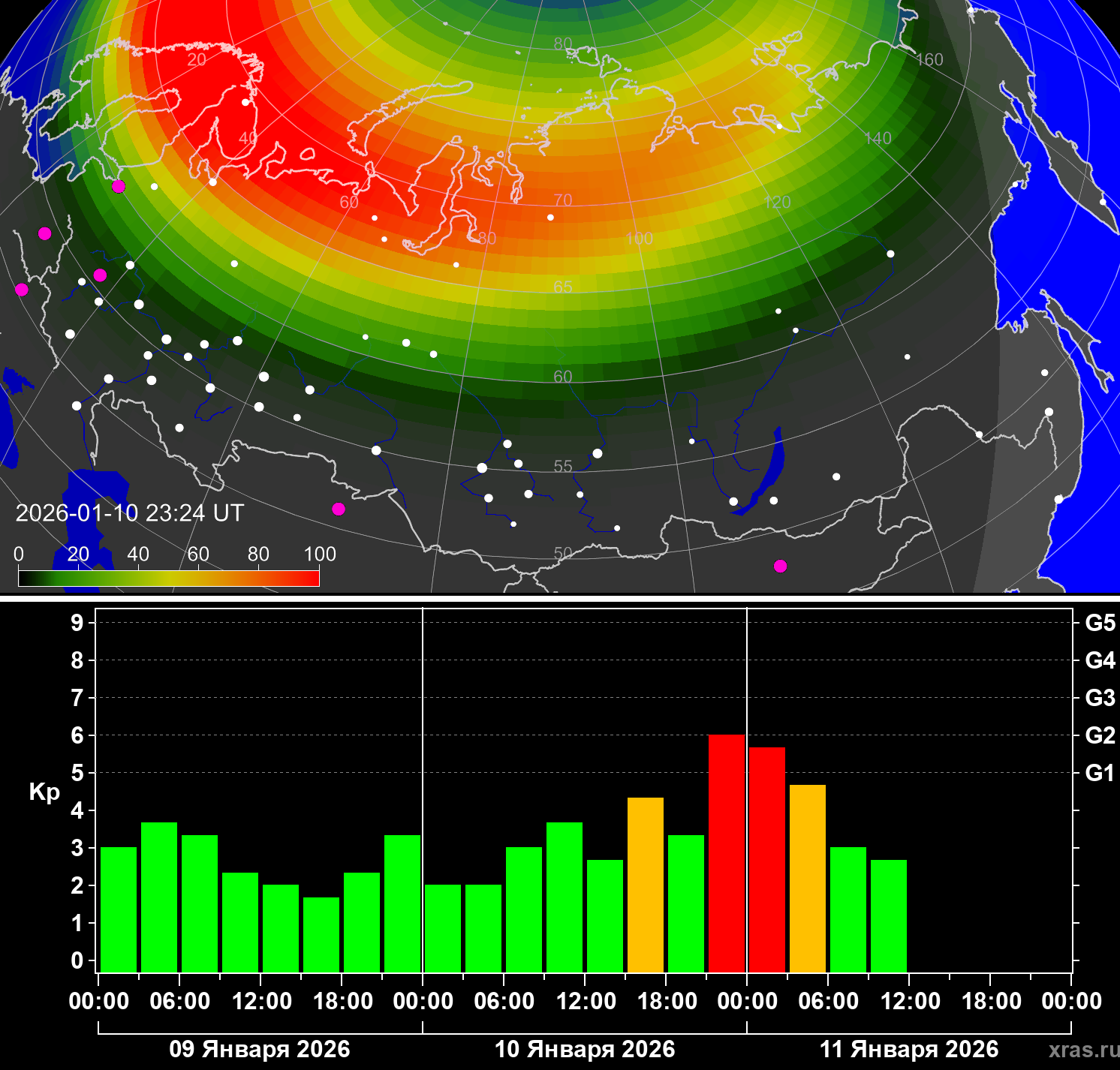
The second magnetic storm of 2026 occurred last night and was accompanied by unexpectedly strong aurora borealis, the lower limit of which in places reached latitudes of approximately 50 degrees. The aurora peaked between 1 and 3 a.m. Moscow time and reached a maximum intensity of 10. Observation of the aurora borealis was severely limited by weather conditions. Much of the European part of the country and the northeastern regions are currently in a low-pressure zone, with clouds obscuring the sky. Observation conditions were favorable in the Kemerovo and Chelyabinsk regions, the Khanty-Mansi Autonomous Okrug, parts of the Murmansk region, and over a significant portion of Europe—in the Scandinavian countries and even further south in Poland and Germany.
The storm was a reaction to the arrival of a plasma cloud ejected by one of the weak flares that occurred in the past few days. Based on the timing, this event is likely the one in question. The forecast, however, was for a significantly weaker event, which, moreover, was not expected to begin until midday. The earlier arrival of the plasma cloud and the very high intensity of the auroras were unexpected.
Currently, based on data received from orbit, the Earth is still within the plasma cloud. Aftershocks are possible.