
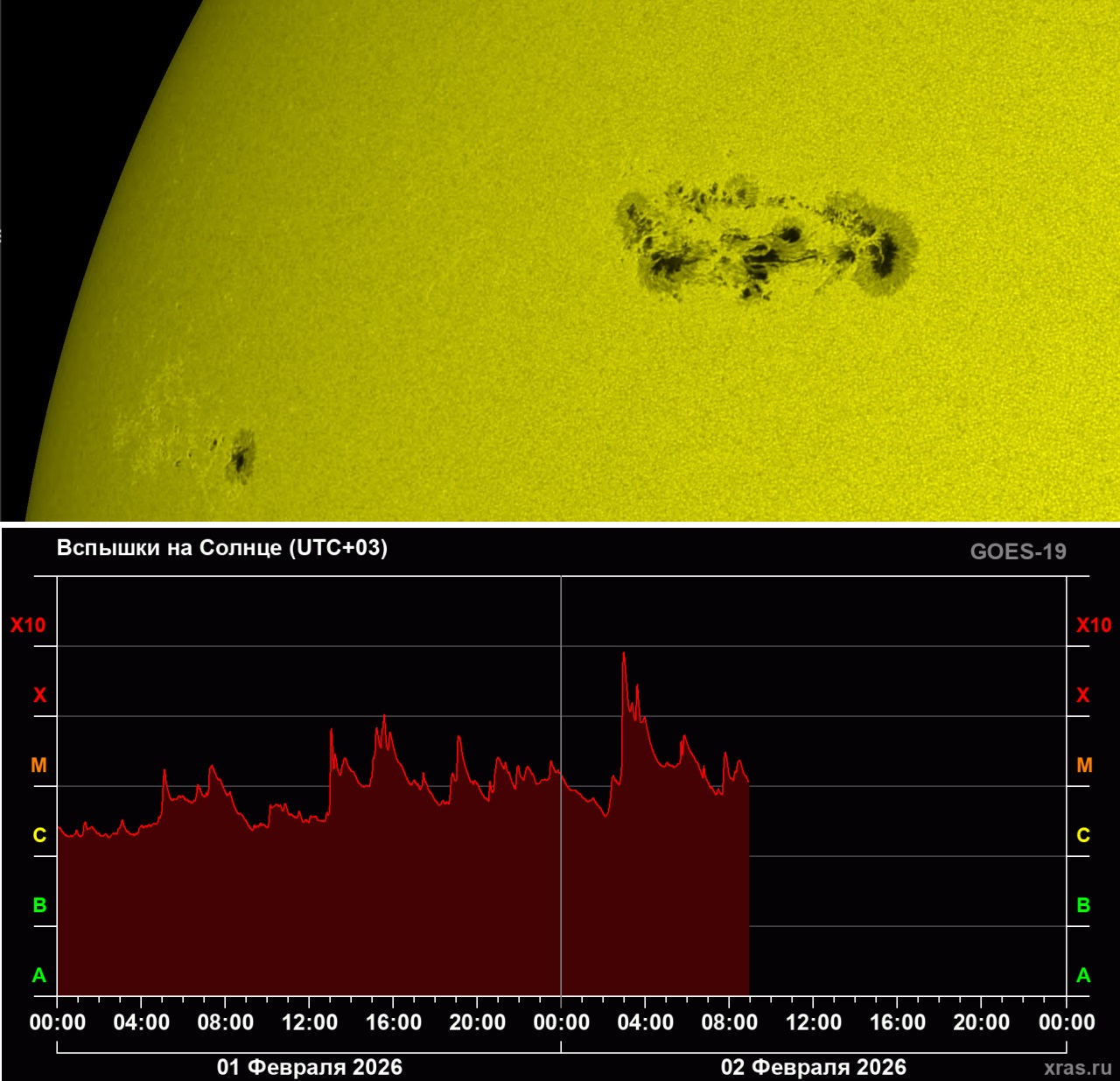
A major center of activity has formed on the Sun, containing exceptionally large reserves of energy accumulated deep within the Sun and now being brought to the surface in the form of electric currents and strong magnetic fields. These concentrated areas are now forming numerous sunspots on the surface. This region is relatively compact and, simply put, is "choking" on this energy and burning it by all available means, continuously producing large flares. Since, apparently, strong and very strong flares are no longer sufficient, superflares have been used.
There are no signs of a decrease in the energy reserves in the active center. Strong flares will continue. New large explosions are possible.
An X8.1 event is, without any exaggeration, a superflare. Over the past quarter century, since January 1, 2001, there have been only 13 such and larger explosions on the Sun. That is, on average, one every two years. Tonight, such an event occurred.
Not every flare of this magnitude affects Earth. In particular, the two previous events of the current cycle, which occurred in 2024—X8.7 and X9.0—did not impact Earth. The flare could be at the edge of the disk, the flare could occur without plasma ejection, or the ejection could be directed sideways—there are many possible causes, and the answer is more often "no" than "yes." Details matter every time.
As for details, an impact on Earth has not yet been confirmed for this event. There's a 90% chance it won't. According to the available data, powerful plasma clouds that would generate the main impact force were not formed, and those that were were directed sideways. Final confirmation will be received today, but the flare is preliminarily "sterile" (without geoeffective ejection).
Now a few downsides. First, by the end of today, the active center will approach the Sun-Earth line and will remain in the zone of most effective impact until Saturday. Avoiding it will be impossible. Furthermore, no large plasma ejections have yet occurred from the center, but that doesn't mean there isn't any plasma there. It just hasn't been able to break through yet. Against this backdrop, a flare with a very large ejection is possible. A slight advantage is that the plasma from the current superexplosion was ejected upward at an angle, past the planets. Generally, active centers tend to operate according to a common pattern, and future ejections may follow suit. But this isn't guaranteed.
In short, that's all that can be written for now. Science, like everyone else, is currently in observer mode. We'll update you as news comes in.
The size of the active center and the associated sunspot group allows them to be reliably observed from Earth, even with amateur telescopes. This field has already written its mark on solar physics, and getting a personal photo of it can be inspiring.