
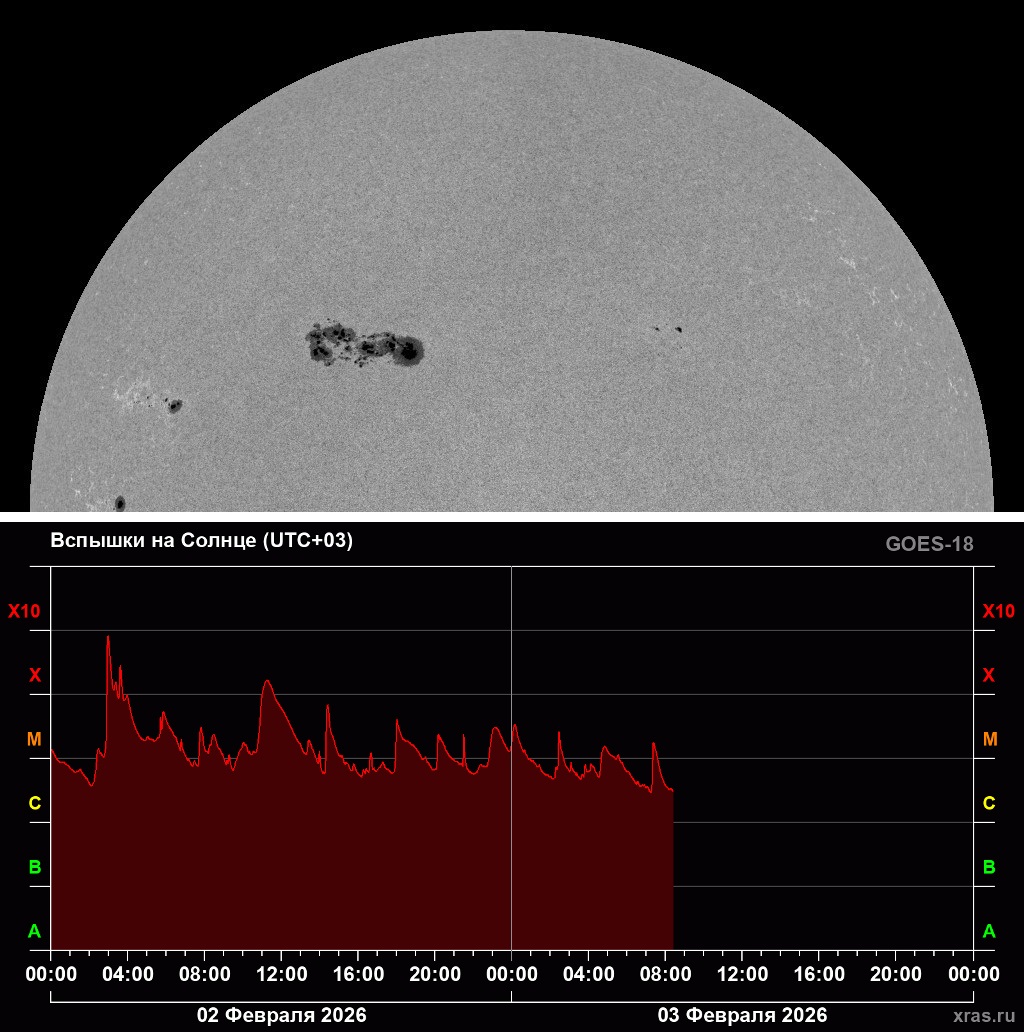
The solar opera, drama, tragedy, or comedy of early February (let everyone decide for themselves) is entering its climax. From today until mid-Friday, February 6, the active center will be in the zone of direct impacts on Earth, at angles ranging from approximately ±20° from the direction of the planet. In the case of large mass ejections and their normal propagation (vertical to the solar surface), the interaction of plasma clouds formed during this period with the Earth's magnetosphere will be virtually frontal.
Frankly speaking, the Earth rarely experiences frontal impacts from large flares. The ±20° angle range is 1/9 of a full 360° rotation, meaning that only about 10% of the total number of major solar events occur directly opposite the Earth. Last year, 2025, there were only two such cases: June 1, 2025, after the M8.1 flare of May 31, and November 12, 2025, after the X5.1 flare of November 11. This year, one such event has already occurred—the magnetic storm of January 20-21, 2026, with the largest radiation storm of the 21st century following a direct hit from the X1.9 flare of January 18.
No prediction is possible here. All such events are black swans. If you don't believe me, go to this graph, which shows one of the largest flares in history, mentally or physically cover the flare with your hand, and ask yourself honestly if there's anything in the remaining open left side of the curve that indicates one of the major events of the century is about to occur. And the honest answer is NO. Therefore, all the study of the current graph, discussions of whether it's falling or rising, stable or moving, are irrelevant; The previous graph, by the way, was clearly bottoming out before the flare. Once again, such events are black swans and cannot be predicted.
The day before, the active region increased its area by 50% in 24 hours, setting a new record for the number of strong flares (M+X) in a single day. Moscow time, there were 18 such events, and UT, 19. In both cases, this is the second-highest number in a decade. December 29, 2024, still holds first place (23 events). Visually, the graph shows signs of decline, which could mean something, but is even more likely to mean nothing. Most likely, with its new increased size, the active center simply developed internal reservoirs for accumulating energy, and the need for mass flare spam (in the absence of a buffer for storing energy) has disappeared.
We certainly won't make any predictions or even pretend that such a thing is possible in this case.
We just intend to look at the color of the swans for 4 days.