
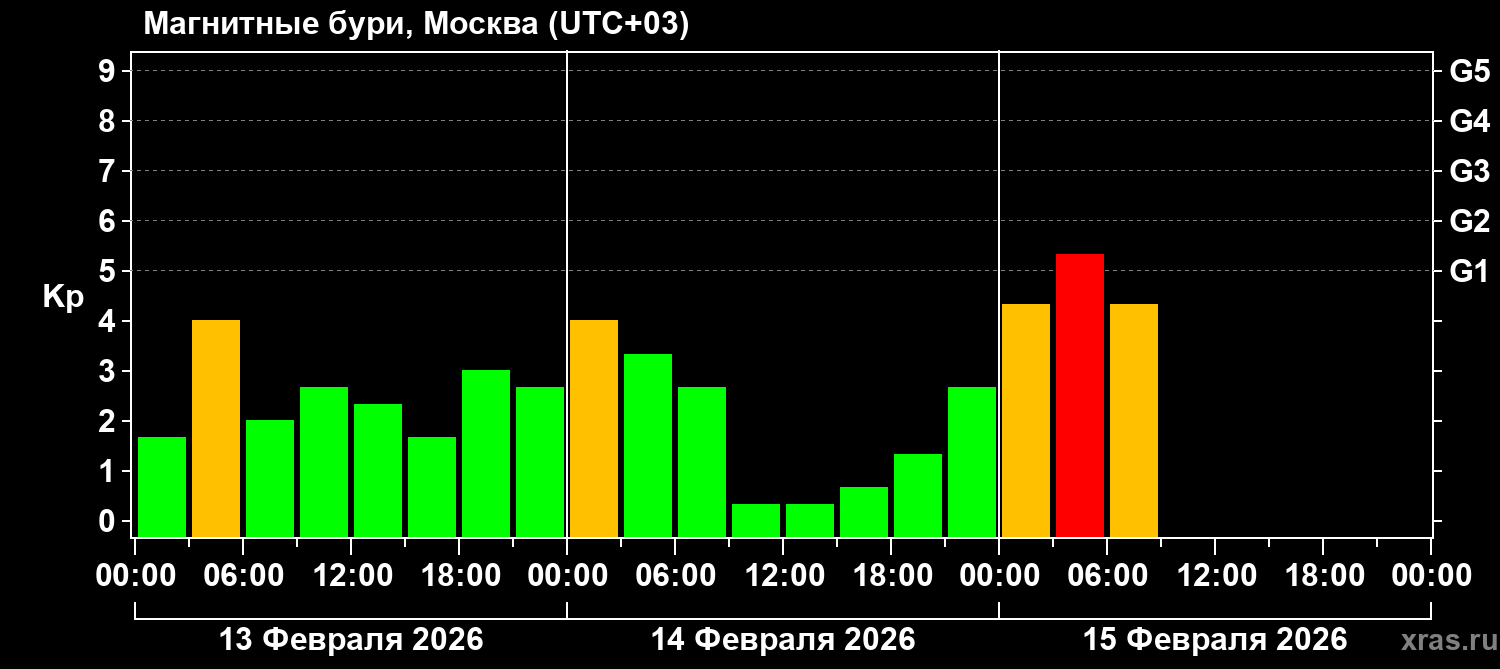
The planet's second magnetic storm of February began overnight, currently rated at weak to moderate intensity. The event peaked at around 2:00 a.m. UTC and registered a G1.3 on a scale of 1 to 5. The event has obvious causes—a fairly large coronal hole is located opposite the Earth on the Sun—but it began about a day earlier than expected.
An earlier magnetic storm (also weak) was recorded this month on February 5th. Thus, the gap was 10 days. So far, February 2026 appears calmer than the previous month. However, last January, which, as previously reported, set a decade-long record for the number of days with magnetic storms, the main activity occurred in the second half of the month.
The total duration of the disturbance period that began overnight could be up to two days, but with a highly uneven impact: isolated bursts and short storms during this period may alternate with fairly prolonged "green" periods. A storm reaching a level above G2 (moderate) during this period is considered unlikely.
At night, amid geomagnetic disturbances, a noticeable increase in the brightness of the auroras was observed. The auroral intensity index peaked at 8.6 on a 10-point scale, which is considered quite high. Good observation conditions occurred between 1 and 5 a.m. Moscow time. Most observations were reported from the northwestern regions of the country. There were no reliable reports of observations in the central regions (Moscow and surrounding areas).
Opportunities for observing auroras over the country will continue for approximately three more months, until mid-May. After that, due to the shortening of nighttime hours and the high altitude of the Sun above the horizon, observations will become virtually impossible even for record-breaking events.