
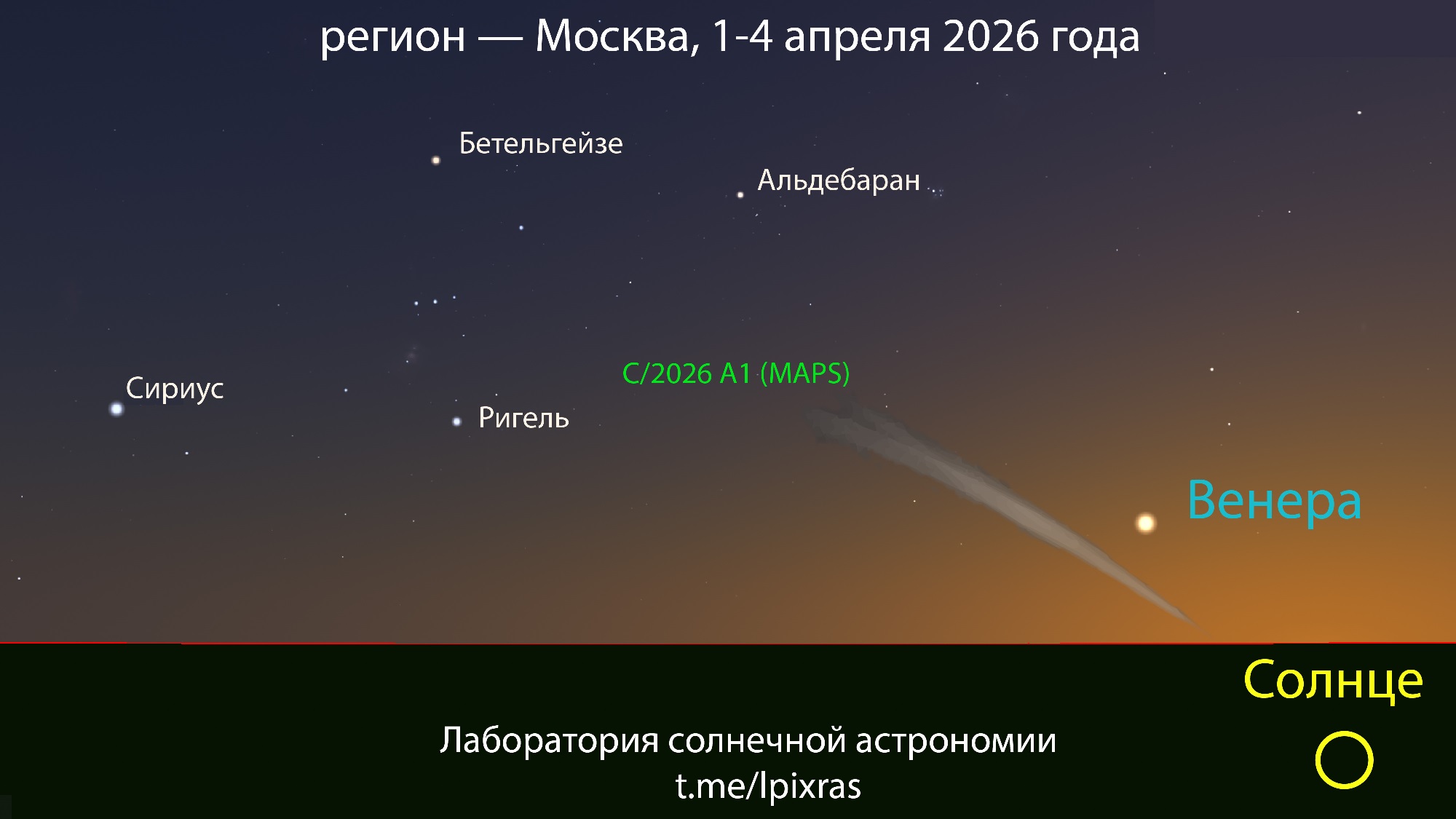
Comet C/2026 A1 (MAPS), likely a fragment of the Great Comet of 1106, currently has no chance of escaping its previously predicted fate. Exactly 30 days from now, on April 4, 2026, the comet will fall into the Sun and, most likely, evaporate like a drop of water in the unbearable heat of the solar corona, already several hundred thousand kilometers from the star's surface. Due to deceleration in the dense solar wind, the influence of solar flares, and the enormous jet acceleration associated with the powerful evaporation of volatiles upon approaching the star, the precise trajectory of the comet will remain uncertain until the very last moment. But even the most optimistic scenarios, in which the comet's nucleus misses the Sun by 100,000–200,000 kilometers, essentially leave the object no chance of survival. Most celestial bodies that are unwise enough to approach the Sun disintegrate at a distance of several million kilometers.
The final days of the celestial body's life will likely be visible to the naked eye, including from within the country. Calculations show that the sharp increase in the size of the comet's tail as the comet approaches the Sun, combined with the increased light illuminating the tail, will lead to an explosive increase in the celestial body's brightness in the final 3-4 days, potentially making it visible not only in the night sky but even in the daytime sky. The latter possibility (the possibility of seeing a comet during the day) is not unrealistic and has occurred several times in human history.
Since its discovery in January, the celestial body has already increased in brightness by 30 times and currently ranks fifth on the list of comets, with a magnitude of approximately +11.6. Over the next 10 days, its luminosity should double, after which it will top the catalog and become theoretically observable in relatively simple amateur telescopes (with some allowance for the difficulty of observing due to its proximity to the Sun). Searches for the celestial body will be possible at sunset, for approximately an hour and a half after sunset. The main explosive increase in the comet's luminosity is expected to begin in the last days of March, when the comet's increasingly majestic tail begins to grow in the sky each day.
Space telescopes and coronagraphs will allow us to directly observe the moment of the comet's demise in images transmitted from orbit on April 4.
History is replete with instances of large celestial bodies breaking free from the sun's embrace and, after being mentally buried, unexpectedly emerging "alive" from the solar corona. The most recent widely publicized instance occurred in 2011, when comet C/2011 W3 pulled off a similar feat. However, it appears to have passed further from the Sun's surface than predicted. It's possible that Comet C/2026 A1 (MAPS) could, with a blink of an eye, repeat this feat. However, estimates of the comet's nucleus size—around 2 km—leave little chance of this happening: a poppy-seed-sized speck of dust would have to zip right past a fiery ocean 1.5 million kilometers across. We wish it luck.