
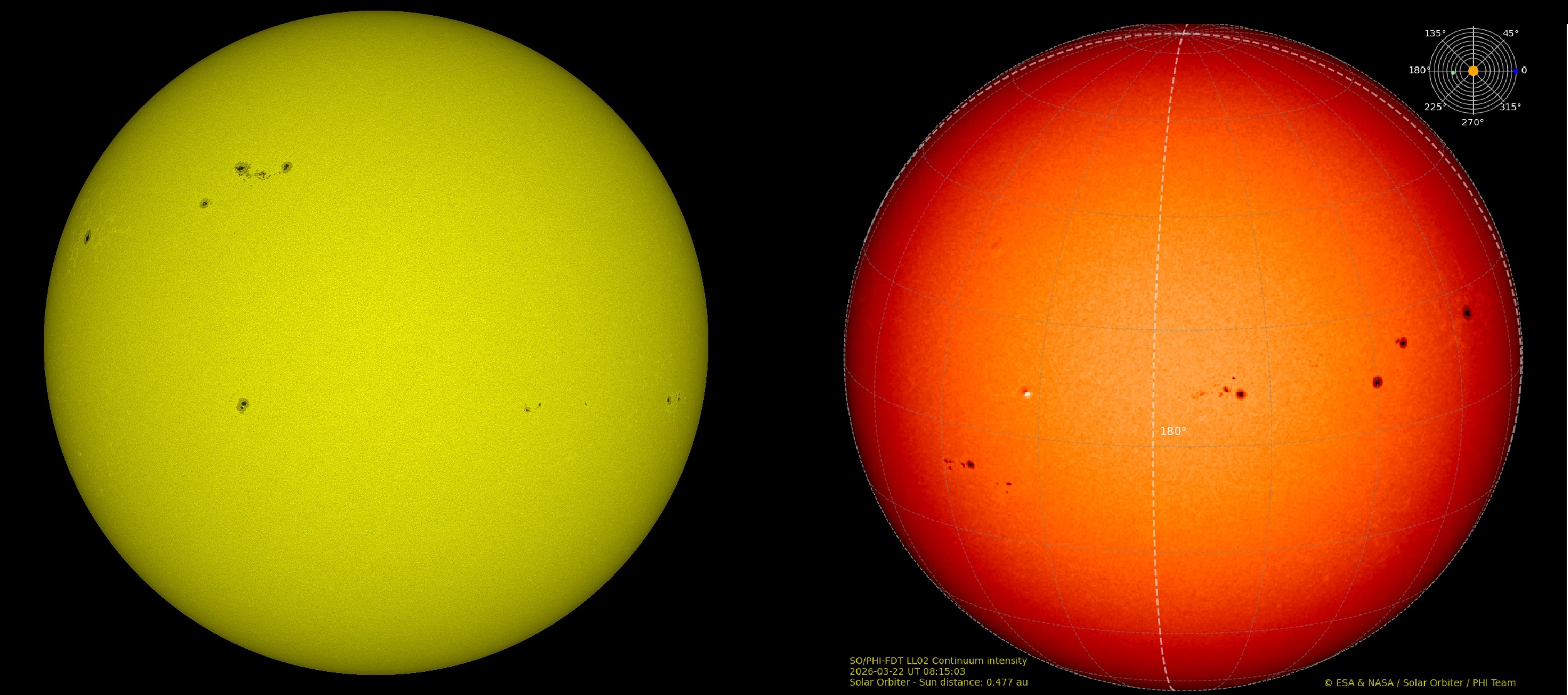
The European Space Agency's Solar Orbiter spacecraft, orbiting the Sun, has reached the exact opposite side of its orbit from Earth. This means that humanity can now observe the entire Sun—both its Earth-facing and its farther-facing side.
This geometrically precise configuration will remain in place for a few more days, and then will gradually begin to disintegrate as the spacecraft begins to overtake Earth. However, a significant portion of the solar surface invisible from Earth will remain observable for several more months. By late spring, approximately two-thirds of the far side will remain accessible. By late summer, the spacecraft will finally overtake Earth, positioning itself between it and the Sun and observing the same objects as near-Earth telescopes.
An interesting fact is that neither flares nor sunspots observed by the spacecraft during this period will be included in global catalogs. Only events recorded on the Earth-facing side will continue to be recorded. Otherwise, the number of flares in catalogs during this period would have doubled, which could subsequently lead to confusion in solar activity estimates, creating the illusion that it briefly increased by 100%.
In the images: on the left is the Sun as seen from Earth (HMI telescope on SDO); on the right is the far side of the Sun as seen by Solar Orbiter (PHI instrument).