
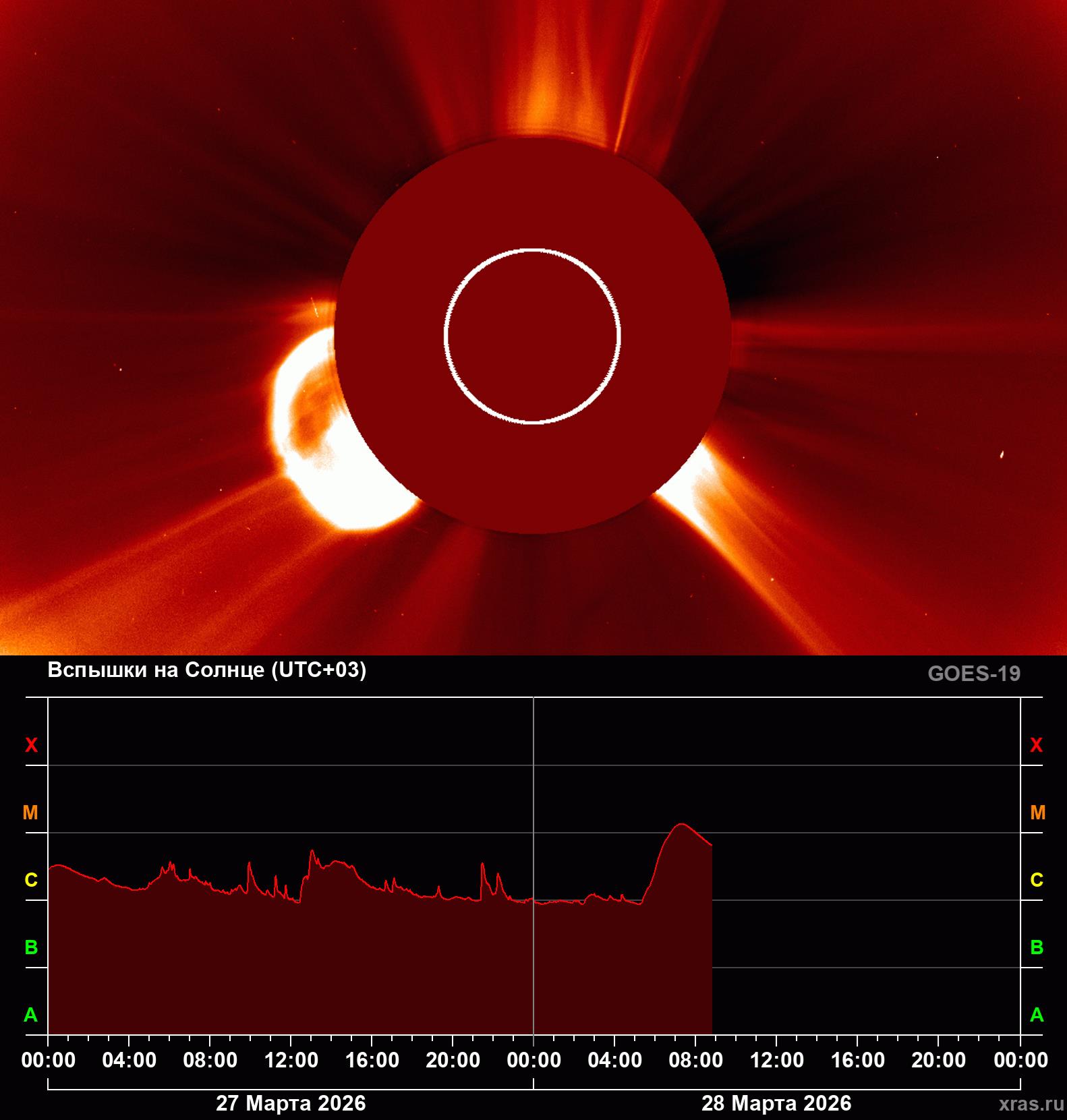
Based on coronagraph data and X-ray profiles, a major plasma ejection is currently developing on the Sun. This event is attracting attention, in part because the first manned mission to the Moon since 1972 is scheduled for the night of April 1–2. During this mission, a crew of four will leave the protective influence of Earth's magnetic field for the first time in over half a century. Unlike near-Earth orbits, where only secondary effects of space weather (magnetic field fluctuations, changes in atmospheric density, and an increase in the number of charged particles) are possible, in deep orbits, the spacecraft finds itself directly within the solar plasma cloud that envelops the planet for several days. Therefore, solar activity will be monitored especially closely in the coming days. The last known delay in the launch of a deep-space mission occurred last November, when NASA, according to an agency statement, postponed the launch of the ESCAPADE satellites to Mars due to solar activity.
At present, the answer to the question of whether plasma can reach Earth is more likely "no" than "yes." The cloud's center, according to the data currently available, is angled approximately 60° from the direction of Earth and is also noticeably displaced downward. Given these initial data, only marginal impacts by the outermost peripheral parts of the plasma cloud are possible. We'll see what the calculations reveal. Meanwhile, judging by several signs, a systemic increase in solar activity is beginning on the Sun, which may continue throughout the next week. If this becomes clear, this factor will have to be taken into account.
Today, we will publish the calculation of plasma movement.