
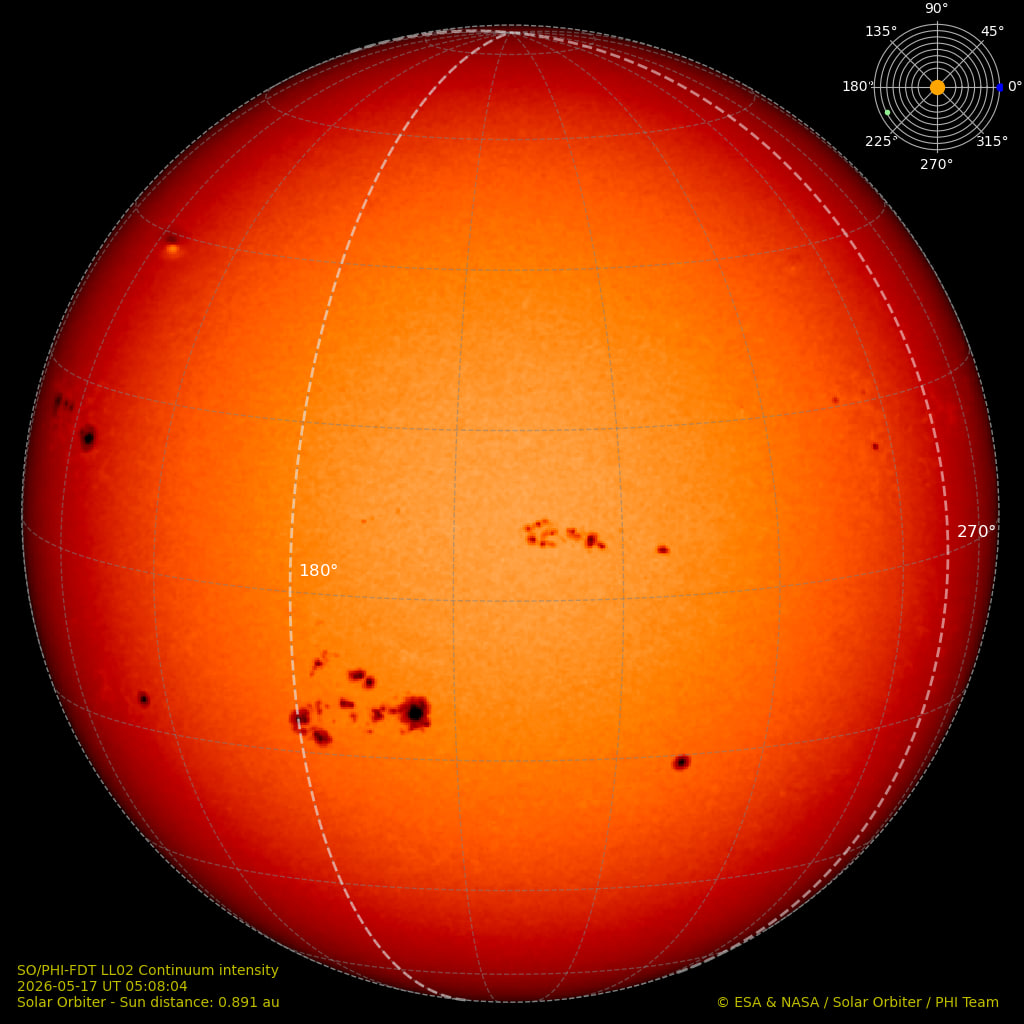
A truly incredible group of sunspots has formed on the far side of the Sun and is currently being observed by the Solar Orbiter spacecraft. The 180° line in satellite images indicates the solar longitude opposite Earth—the center of the far side. The 270° line is the left edge of the solar disk visible from Earth. Everything to the left of this line is hidden from observation. Everything to the right is visible from Earth.
Frankly, it's hard to immediately recall anything comparable on the Sun over the past year. The closest association, both in size and position on the solar disk, only comes to mind two years ago—region 3664 (center in this image), which was observed in the first half of May 2024. A series of explosions there, followed by impacts on Earth, triggered the strongest magnetic storm in the last 20 years. Large sunspot groups attract attention primarily because the size of an active region is usually directly proportional to the intensity of the solar events occurring there. This is because flares draw energy from the Sun's magnetic field, and the flux and strength of the magnetic field, in turn, are directly related to the size of the sunspots. As a result, the most powerful flares in history have, without exception, occurred in active regions of record size.
Since the Sun, as observed from Earth, completes a full rotation every four weeks, this region will appear in Earth's field of view on the left side of the Sun in about a week, and then it will take another week for it to move to its most dangerous position—directly opposite Earth. Strictly speaking, two weeks is a huge period for sunspot groups: during this time, they can appear, produce a series of flares, and disappear. For this reason, it is completely impossible to predict what will remain of this group in 14 days. At this point, the active region appears to be only gaining energy, and there are no signs of strong activity on that side of the Sun. If large explosions occur there, they will be visible from Earth as plasma clouds emanating from the edge of the Sun. Currently, there are no such signs.