
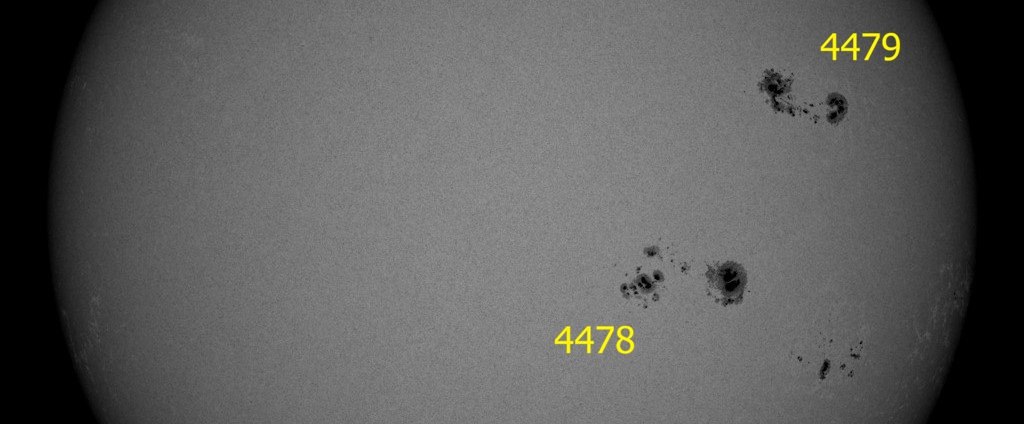
Sunspot group 4478 has further expanded in size over the past 24 hours, reaching an area of 1,550 units. Over the past decade, it is second in size only to the legendary active region 3664, observed in May 2024 and responsible for the strongest magnetic storm in 20 years on May 11-12 of that year.
Companion region 4479, located approximately half a million kilometers northwest of the main sunspot (on the Sun, the west is on the right), also continues to grow.
Flare graphs show a sharp increase in activity (explosions on the Sun are essentially continuous), but this increase is still approximately 5-10 times smaller than predicted values, given the size of the structures observed on the Sun. The reasons for this discrepancy are not entirely clear.
Within 24 hours (most likely starting Thursday night into Friday), the first plasma ejections from these sunspot groups will begin to reach Earth. Although extremely strong solar explosions have not yet been recorded, the impact will likely be noticeable—in the G2 to G3 range, which could mean the strongest storm in months. The chance of observing auroras in the Northern Hemisphere is minimal: the nights are too short and the skies too bright.
The Sun\'s rotation is currently moving active centers westward from the Sun-Earth line at a rate of about 13° per day. By the weekend, this will likely lead to complete \"sterilization\" of the situation—spot groups will be so far away that even record-breaking flares will no longer be able to affect Earth. Today is likely the last day when frontal impacts on the planet are still possible.
As for the gaps in the flare graph, they are objective. Yesterday, a failure occurred, resulting in the simultaneous loss of data from two GOES spacecraft—the primary (number 18) and the backup (number 19). At the moment, everything has been restored, information is coming in in real time.