
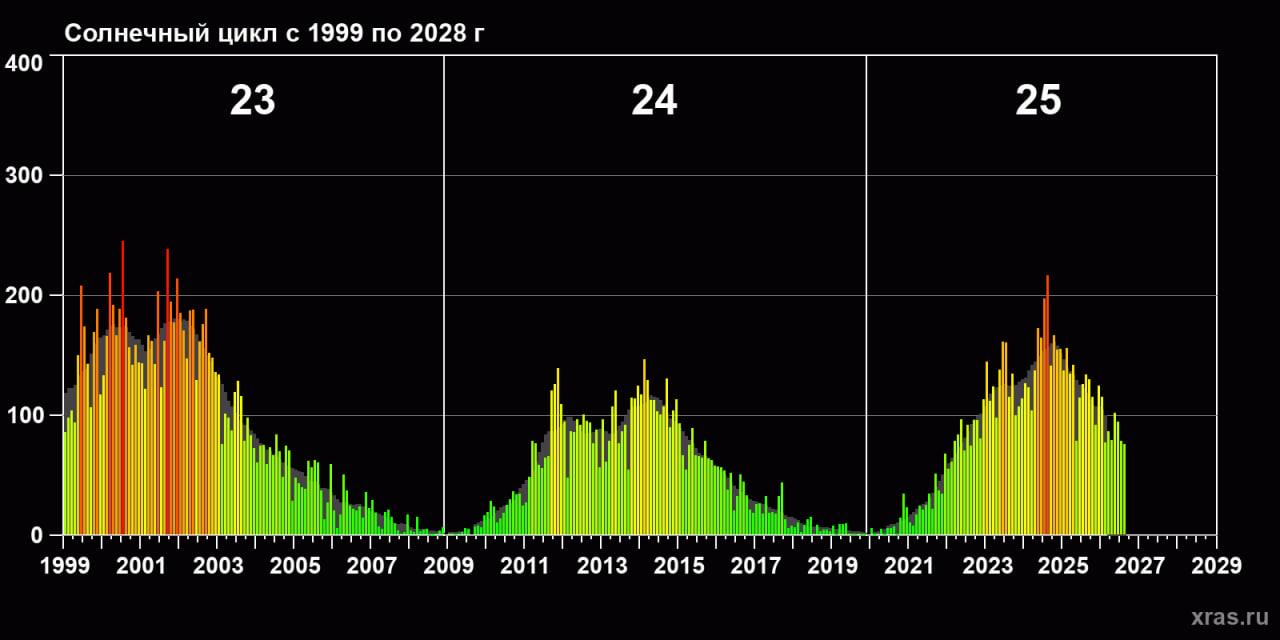
Over the past 24 months, solar activity has dropped nearly threefold—from a level of 216 units in August 2024 to 76 units in August 2026. Solar activity indices have been calculated based on sunspot counts for nearly 280 years (since 1749) and serve as the primary method for comparing solar activity across different historical periods. Some of the highest values during this time were recorded in the mid-20th century, while the lowest occurred between 1800 and 1825—the first quarter of the 19th century.
In recent months, solar activity has been declining faster than predicted. Specifically, based on the averaged characteristics of solar cycles, an index value of 90 was expected for August; however, the actual value of 76 was 16% lower. If this trend persists, the solar minimum could be reached 1 to 1.5 years ahead of schedule—as early as 2029. It is worth noting that shorter solar cycles are almost invariably followed by particularly intense cycles. Regardless, an increase in solar activity is expected in the coming period, as the Sun is moving toward a centennial maximum projected for the middle of this century.
The likelihood of major new solar flares occurring during the current cycle remains unclear. In the two previous cycles, the most intense solar events did not occur at the peak of activity but rather in the one-to-three-year period following the solar maximum. No such events have occurred in the current cycle so far. While this pattern is not a strict rule, it is frequently observed as a characteristic feature of solar activity. It remains to be seen whether the current cycle will prove to be an exception.
At present, flare activity remains subdued, with background levels corresponding roughly to the B5 class. This is 200 times lower than the threshold for the highest-level X-class flares. There are currently no signs of resources that could drive a rapid increase in activity.