
The space weather forecast for the next 2–3 days has become reasonably clear. Calculations indicate that the plasma cloud ejected by the Sun yesterday midday will take nearly three days to reach Earth, arriving on Friday morning. The impact will trigger the usual chain of space weather phenomena—ranging from magnetic storms to auroras—but in a relatively mild form. The storms are expected to last 10 to 12 hours (a short duration) and will not exceed a moderate G2 level. As for the auroras, the plasma's morning arrival means they won't be visible; it is currently difficult to say whether the bright auroral oval will persist until nightfall.
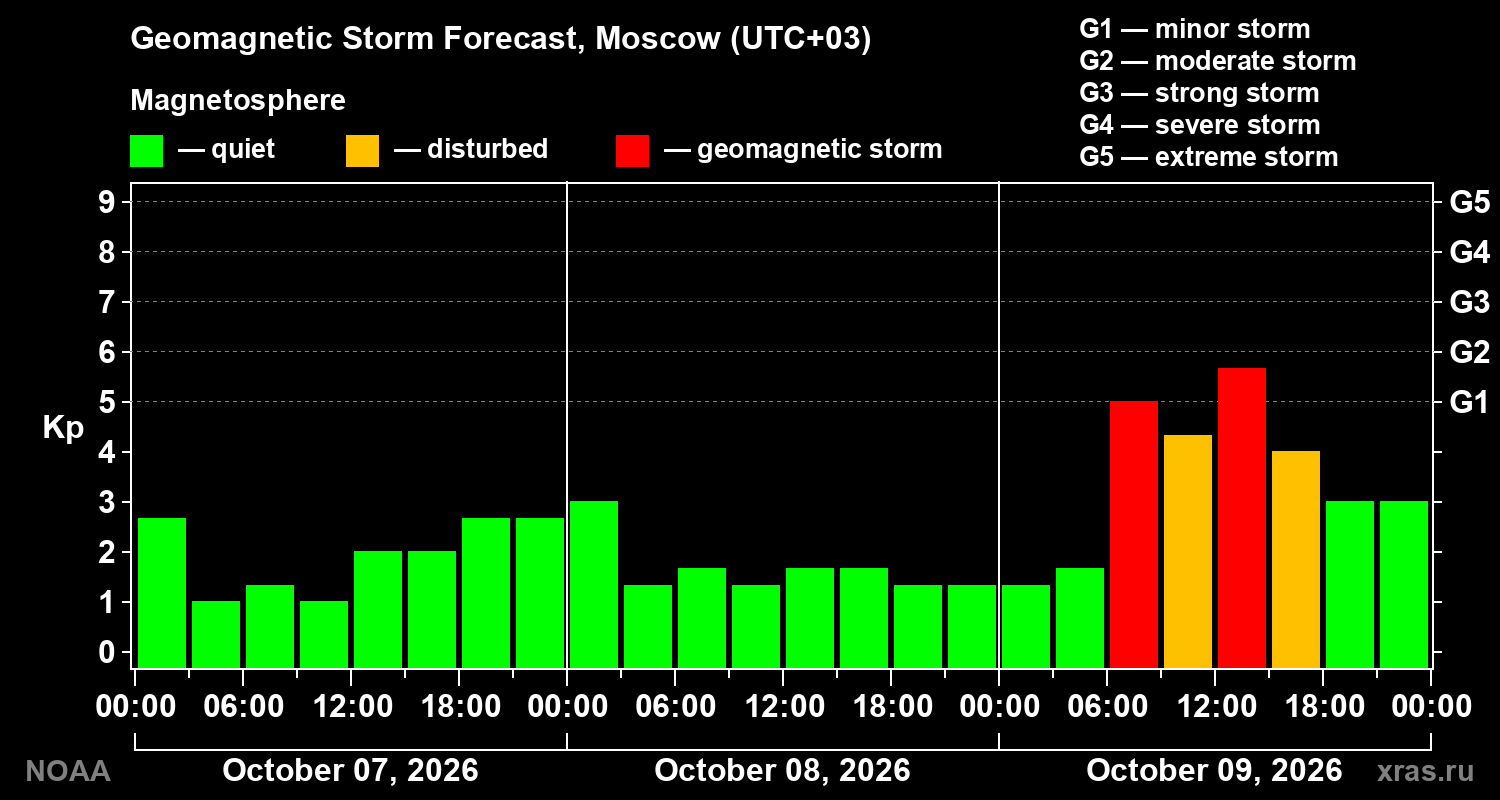
For the moment, the growth of active regions on the Sun has stalled, leading to a sharp drop in the intensity of observed flares. While the Sun hinted yesterday at potentially crossing the X-class threshold, that now seems unlikely. Activity has subsided to the "C" level, with no signs of a return to yesterday's state. Even assuming energy is accumulating rather than being depleted, the Sun's rotation is rapidly carrying the active centers away from the Sun-Earth line toward the western limb—a position from which even an X10 flare could not reach Earth.
All in all, for now, we simply await Friday's storm while keeping an eye out for any signs of a "second act" in the drama.