
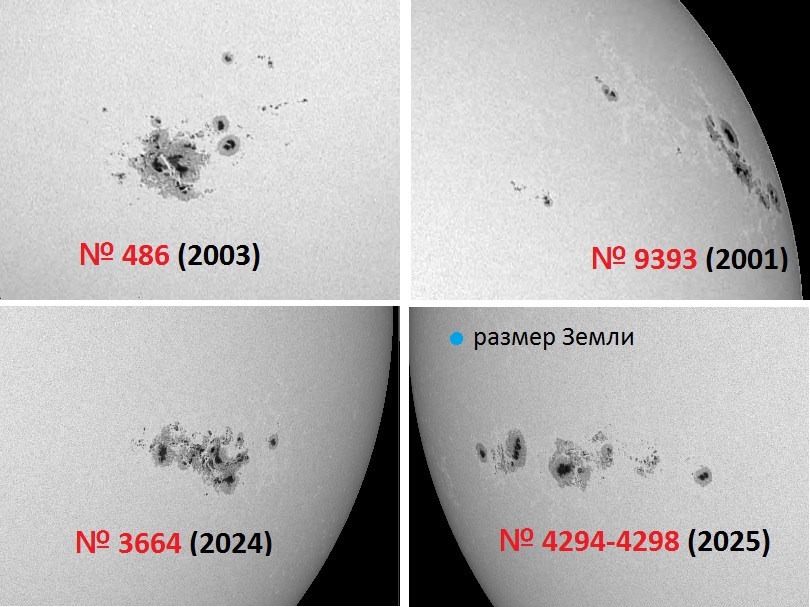
The Sun continues to display one of the largest sunspot complexes in recorded history, formed by three regions with numbers 4294, 4296, and 4298.
The most famous active region of the 21st century is sunspot group No. 486, with a maximum area of 2600 units, observed in late October and early November 2003. Between October 28 and November 4, it hosted two of the largest solar flares of this century, the true intensity of which remains a subject of debate among scientists. The solar radiation intensity was so strong that it exceeded the upper sensitivity threshold of detectors, approximately 17 solar fluences, and therefore could not be measured. Current estimates of the true intensity of the events range from 28 to 45 solar fluences. The first of the two flares struck Earth, triggering the strongest magnetic storm of the 21st century, recorded from October 29 to 31. The second, even more powerful event occurred when the active region was already at the edge of the Sun and therefore did not affect Earth.
Second place goes to region #9393, with a maximum area of 2,400 units, observed in late March and early April 2001. On the night of April 2-3, it officially experienced the largest flare in the catalog, with an X20 magnitude. The ejected plasma clouds then passed by Earth.
Third place goes to the relatively recent region #3664, observed on the Sun in May 2024, with a maximum area of 2,600 units, which produced 12 (!) flares of the highest X magnitude. Some of these events impacted the planet, triggering G5 magnetic storms—the strongest in 20 years.
The sunspot complex currently observed on the Sun reached an area of 2,300 units as of this morning and remains quiet. The flare activity graph is almost a straight line, with a small number of weak C-level flares.
Making a reasonable forecast for the solar flare situation is currently impossible. The evolution of the active center on such a scale is determined by a chain of chance events that can either stabilize the sunspot group until it retreats to the far side of the Sun, or trigger an explosive release of the accumulated energy at any second. For the third day, mathematical estimates have shown the probability of X-class flares to be between 30 and 70%, but in fact, not a single M-class event has occurred here in the last three days. Mathematics is powerless against "black swans."
The active center will enter the region of direct impacts on Earth on Friday, December 5.