
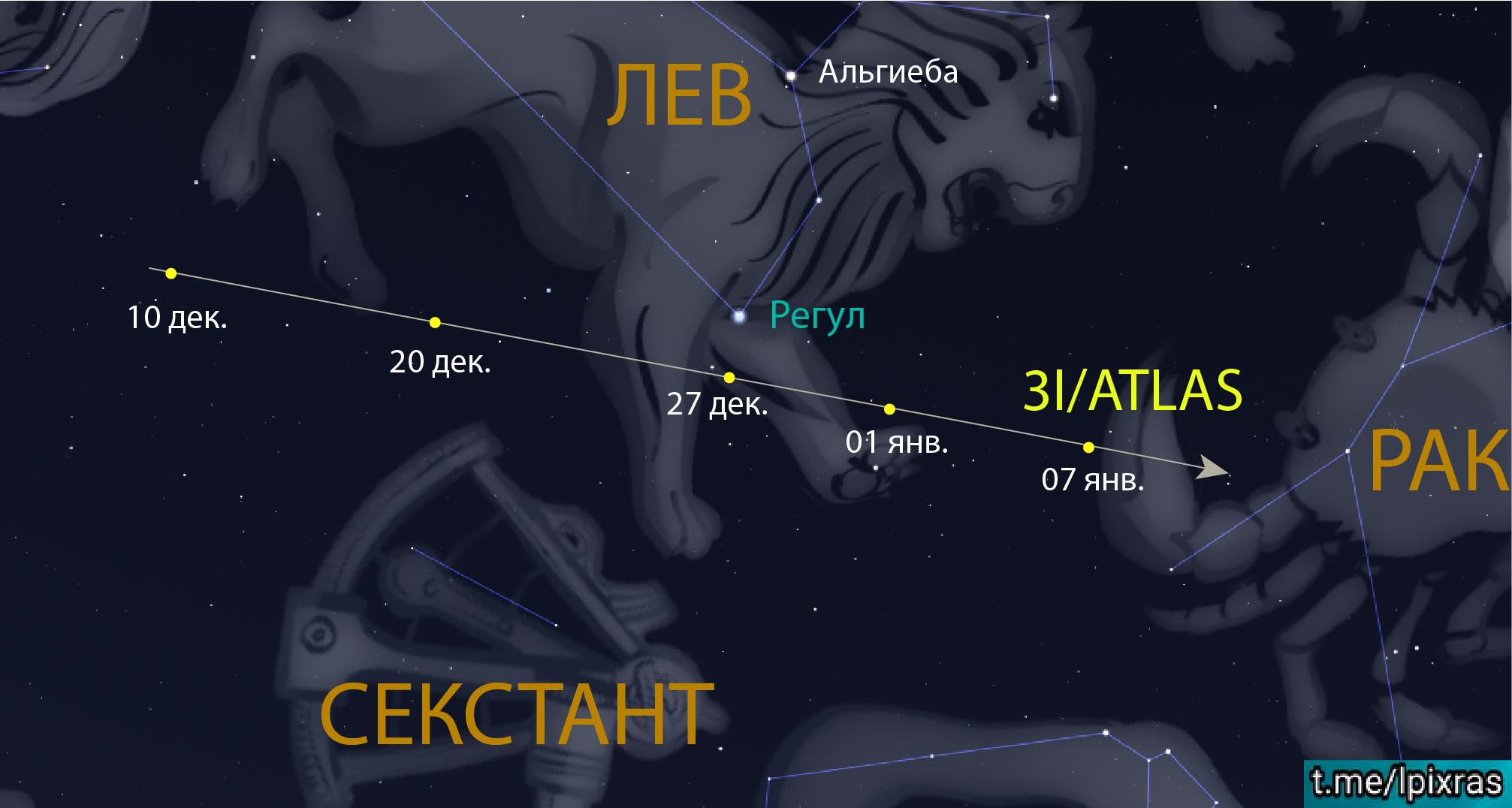
Comet 3I/ATLAS will pass closest to the last bright star on its celestial path today—the star Regulus, located in the heart of Leo. From then on, the celestial body will have no further conjunctions with bright stars until it completely disappears from Earth's field of view, which will occur in the second half of next year. Contrary to popular expectations, the object continues to move along its predicted trajectory, leading it toward its upcoming closest approach to Jupiter in March of next year. Currently, the celestial body is just over 273 million kilometers from Earth, and in the week since its closest approach on December 19, it has moved an additional 4.5 million kilometers away from the planet.
Since the object has a very small inclination to the ecliptic (which has been and continues to be one of the arguments used in discussions about its possible artificial origin), its celestial trajectory lies within the familiar zodiac circle. Currently, the celestial body, as is easy to guess from its proximity to Regulus, is located in the constellation Leo and is moving toward the constellation Cancer, whose border it will cross in early January. Afterward, in the second half of winter, it will move into the next zodiac constellation, Gemini, where it will meet Jupiter. Those who can mentally translate the names of the zodiac constellations into months will easily notice that the body is moving in the opposite direction to the Sun's movement across the sky: from later months to earlier ones.
It will no longer be possible to observe the celestial body exiting the "summer" portion of the zodiac circle. After passing the constellation Gemini, the comet will finally leave first the field of view of instruments, and then the Solar System.