
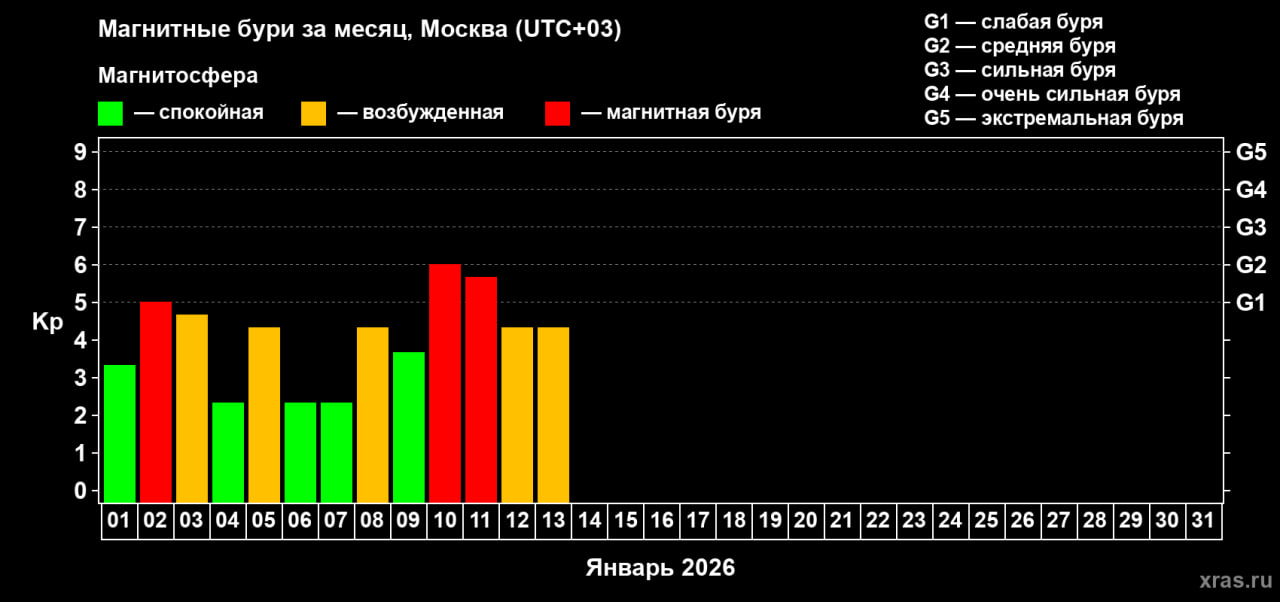
The rate of geomagnetic disturbances (Kp index = 4; yellow level) and storms (Kp index = 5 and above; red level) in the first 13 days of January exceeded the previous year, 2025, which, in turn, was the highest in the past 10-20 years.
Of the first 13 days of the year, 8 were colored yellow or red, or 62% (statistics here and below are Moscow time). Last year, 2025, this figure was 169 out of 365 days, or 46%, which was already a record high since 2005. Furthermore, since the beginning of the year, there have already been 3 days with magnetic storms (23%), compared to 69 out of 365 (18%) last year. Drawing global conclusions and forecasts for the coming year based on the first 13 days is incorrect, but at least a claim has already been made that the previous year's records could be broken in the coming year.
The increase in magnetic storms is observed against a backdrop of declining overall solar activity, which is believed to have peaked in 2024 and is currently moving toward a minimum expected in 2029–2030. The primary cause of magnetic storms is the exceptionally large number of coronal holes, which disrupt the solar wind, which in turn impacts the Earth's magnetic field. There is no current trend toward a decrease in this number. Currently, two medium-sized holes are observed on the Sun.
Current figures, however, still lag behind historical records. In the most active solar year of the current century—2003—geomagnetic disturbances and storms were observed on 272 out of 365 days, or 72% of the time. Only 93 days were calm this year.