
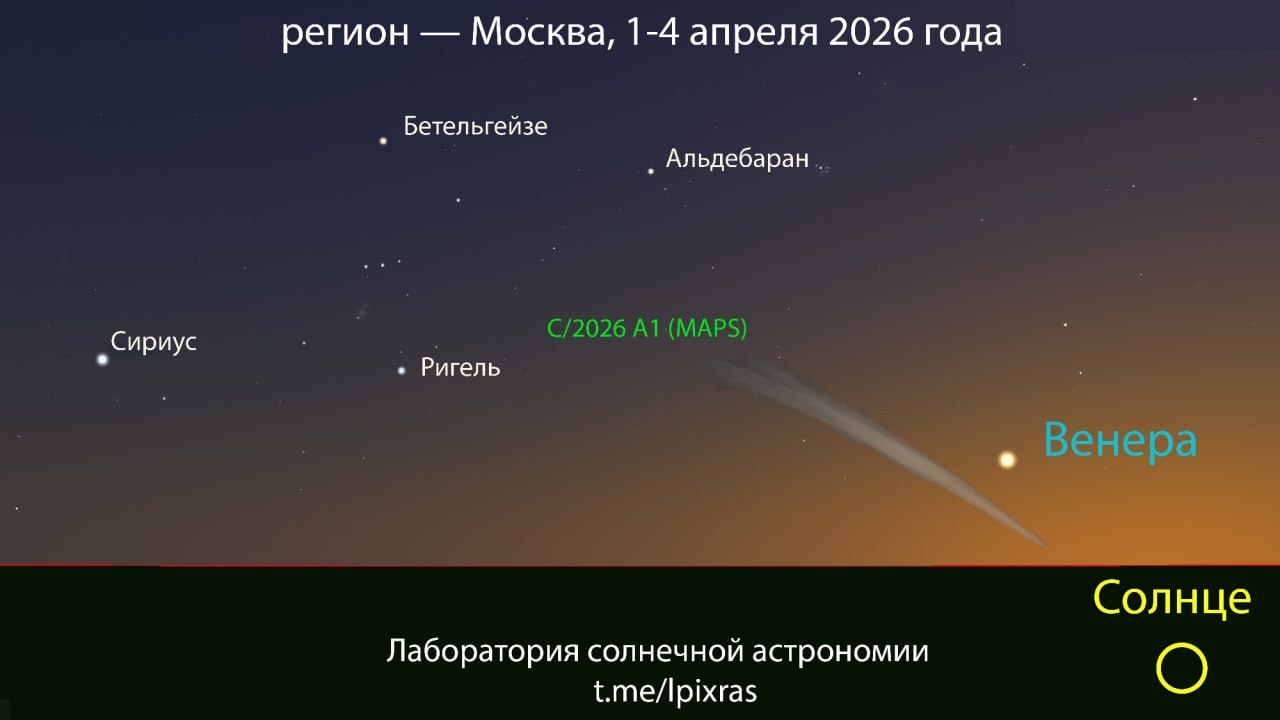
A major update has been made to the catalog of comets currently visible in the sky, which includes some of the faintest bodies. Comet C/2026 A1, which is rapidly increasing in luminosity as it approaches the Sun, rose to first place yesterday in brightness and will hold that spot for the next four days, which is apparently the maximum lifespan of this billion-year-old celestial body.
From an orbital perspective, the comet's fate currently appears completely clear. Currently, the comet is approximately 40 million kilometers from the Sun and is moving toward it at a speed of approximately 80 km/s, which will increase with each passing day. Tomorrow, the comet will accelerate to approximately 90 km/s, the day after tomorrow, April 2, to more than 100 km/s, and on April 4, at the moment of its closest approach to the Sun, which it still has time to reach, it will fly close to it or crash into it at a speed of approximately 300 km/s.
The chances of observing the comet's final encounter with the star were initially slim, but have rapidly fallen to near zero in recent days. Apparently, the comet, now tens of millions of kilometers from the Sun, is no longer able to withstand the intense light and centrifugal acceleration and has begun to disintegrate. The peak of this destruction could occur between April 2 and 4, when the comet begins to enter the distant solar corona (at distances of approximately 10-20 million kilometers), and it will begin to undergo the same explosive disintegration processes observed in asteroids entering Earth's atmosphere. This also offers a certain chance of a rapid increase in the comet's brightness on the night of April 3 and, especially, on the night of April 4. Although the comet's nucleus will be invisible due to its proximity to the Sun, its bright tail, which could extend for tens of degrees in this scenario, could become visible in the sunset sky from across the country.
Around April 2, the comet should approach the Sun close enough to appear in images from the LASCO/C3 space coronagraph. These images are published openly and are available, including on our website (blue image in the bottom row). This will allow us to see the celestial body in detail and possibly provide information for a scientific forecast of its fate over the next two days. The probability that the body will reach the Sun, even if it ends up falling into debris, currently appears to be no more than 1 in 10. The scenario in which the comet survives until a direct encounter with the Sun, manages to miss it, and, passing over its surface through magnetic loops and prominences, emerges intact into open space again is, frankly, difficult to estimate at more than a fraction of a percent.
So, all that remains is to wait. For now, the first benchmark is whether the comet will survive until it appears in LASCO images.