
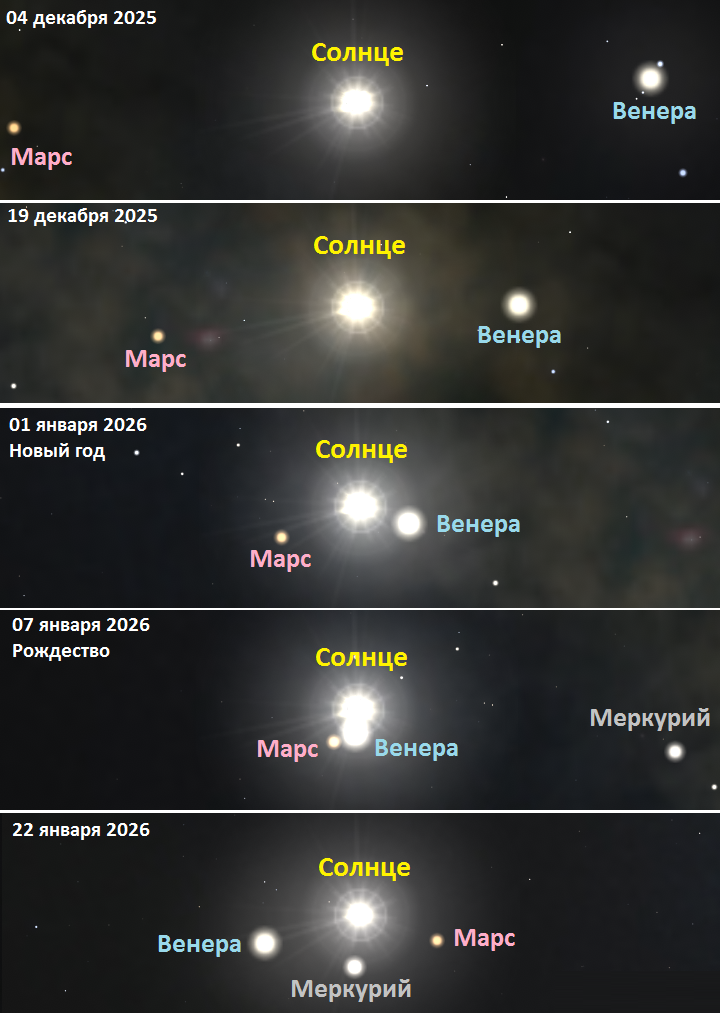
All three planets closest to the Sun as seen from Earth—Mercury, Venus, and Mars—are converging in its vicinity for the first time since the fall of 2019.
Venus was the first to approach the Sun, two days ago, to an angular distance of less than 10 degrees. It is already visible in solar coronagraph images as a bright object on the right edge of the image. Today, Mars approached to the same distance. It is not yet visible to LASCO coronagraphs, but will appear in their field of view by the end of the week.
By December 19 (the date some celebrate as the closest approach of interstellar comet 3I/ATLAS to Earth), Venus and Mars will be within 5-6 degrees of the Sun. On New Year's Eve, they will be separated by about 2-3 degrees, and on Christmas Eve (the night of January 6-7), the Sun, Venus, and Mars will practically merge in the sky, forming a unique Star of Bethlehem. At the same time, a third planet, Mercury, will appear in the solar neighborhood. It is currently undergoing a rotation in its apparent orbital motion and is beginning to catch up with the Sun in the sky.
On January 22, all three planets will be at their minimum average angular distance from the Sun, forming a nearly perfect diamond-shaped configuration with it, marking the culmination of the event. After this, the formation will begin to rapidly disintegrate. The fastest planet, Mercury, will be the first to move away from the Sun, even before the end of January. During February, Venus and then Mars will move away.
The next conjunction of all three planets near the Sun (within 10 degrees) will not occur until September 2038. Their approach, beginning now at an angle of approximately 3 degrees, is possibly unique in this century.