
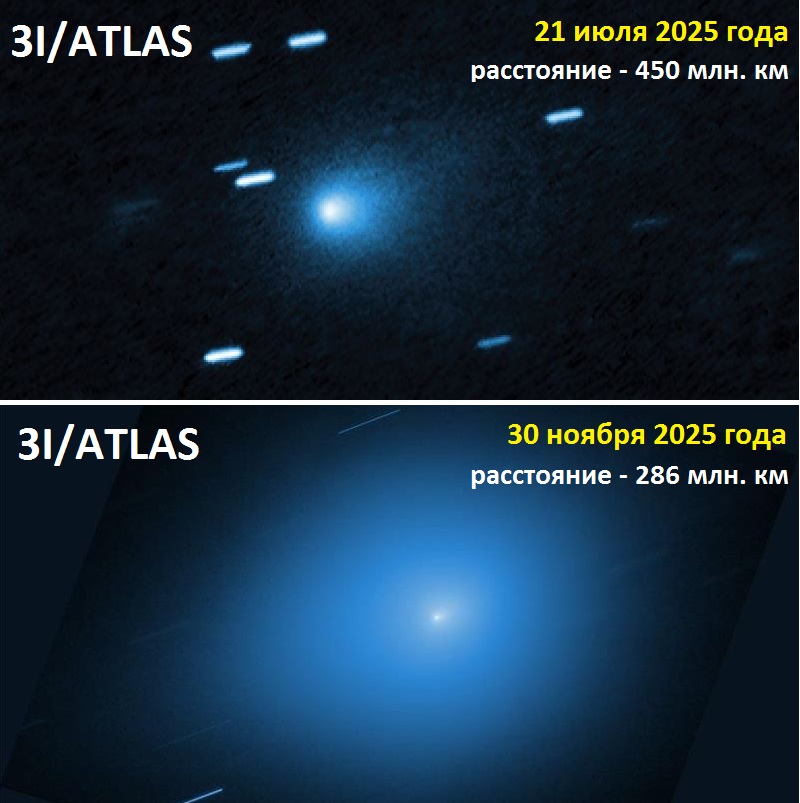
NASA announced that on November 30, it conducted the first repeat observations of 3I/ATLAS since July 2025 using one of its largest instruments, the Wide Field Camera 3 (WFC3), mounted on the Hubble Space Telescope. This instrument is sensitive in both optical and ultraviolet wavelengths, and this sensitivity is largely comparable to that of the human eye. Due to technical limitations, the Hubble Telescope cannot observe objects near the Sun, so it has been unable to monitor 3I/ATLAS for the past several months. Throughout this time, there was uncertainty about whether NASA would decide to point one of its most valuable instruments at the object when favorable conditions arose. Now, an answer has been found.
Although the new images were taken from a significantly closer distance (286 million km versus 450 million km in July), it cannot be said that they reveal any significant new details. It's worth noting that in the past two to three weeks, numerous ground-based images of 3I/ATLAS taken by amateur astrophotographers have appeared online, revealing a significant number of details, in particular the shape of the tail and antitail. It's difficult to definitively confirm all these details from the images published by NASA, which raises many questions, including about the reliability of the ground-based observations. However, the differences may be due to the use of different filters, as well as differences in post-processing. It was expected that the Hubble images would reveal these features of the celestial body in maximum detail, and the paucity of details in the published images is indeed disappointing.
On the positive side, the agency's announcement suggests that Hubble observations of 3I/ATLAS will continue. Perhaps subsequent images will shed some light on the situation.