
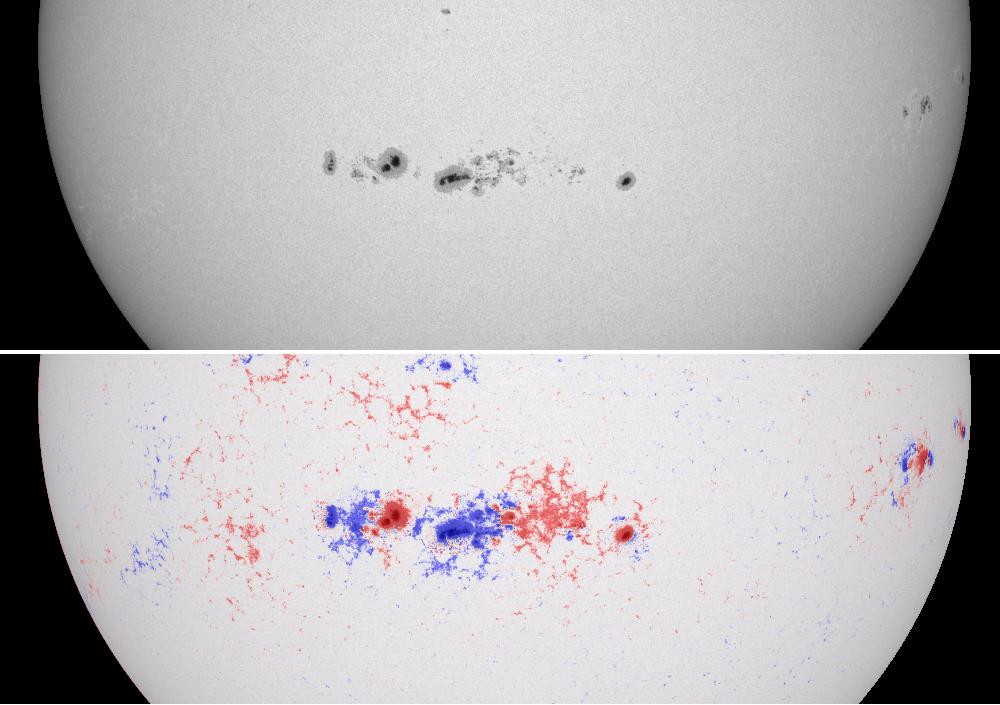
Sunspot complex 4294-4296-4298, which emerged on the Earth-facing side of the Sun a week ago, is currently crossing the central meridian and will pose the greatest hazard to Earth over the next three days. The combined area of the complex continues to exceed the psychologically significant mark of 2000 millionths of a solar hemisphere (m.s.h.), making it one of the largest sunspots of the current century. The key element of the structure is central sunspot group No. 4294, whose area (approximately 1300 m.s.h.) is the largest in 2025 and the second largest in the current solar cycle after region 3664, observed in May of last year.
Region 4294 and region 4296, located to its left, are cataloged as Beta-Gamma-Delta magnetically classified—the highest level corresponding to the maximum potential for flare activity. Region 4298, located on the right, is labeled Beta, meaning it is considered of limited danger.
Despite these record-breaking areas and the "threatening" magnetic classification, as well as the fact that mathematical models predict a nearly 100% probability of M-level flares and a 20-50% probability of X-level flares daily, not a single (!) M-level or X-level flare has been recorded in the past five days, since the beginning of December. The region is silent. An elevated background of thermal X-ray emission is detected, indicating continuous energy release and plasma heating, but the mechanism by which this energy accumulates remains unclear. Distinguishing features include the relatively slow dynamics of the sunspots observed here—with the exception of continuous local rearrangements, the global structure of the complex has changed little over the past few days. At the same time, this stability of the global structure may explain the absence of large-scale X10 flares, but it doesn't explain why there's no response even to local changes such as M flares and the lower boundary of the X. It seems as if energy from all local points is simultaneously "leaking" into some global reservoir, and the entire structure is working only to fill it.
The worst-case scenario in such systems is the unexpected formation of a new large spot in the center of the group. Its appearance typically disrupts the region's stable magnetic configuration, triggering an avalanche-like process of explosive restructuring. Sometimes, the rapid expansion of an existing spot can also serve as such a trigger. Overall, we can only hope that nothing similar will happen over the next three days, and then the group will shift from the zone of direct geoeffective impact to the zone of tangential impacts. With such a size, the consequences could still be significant, but at least the dubious honor of witnessing the rewriting of historical records will be avoided.